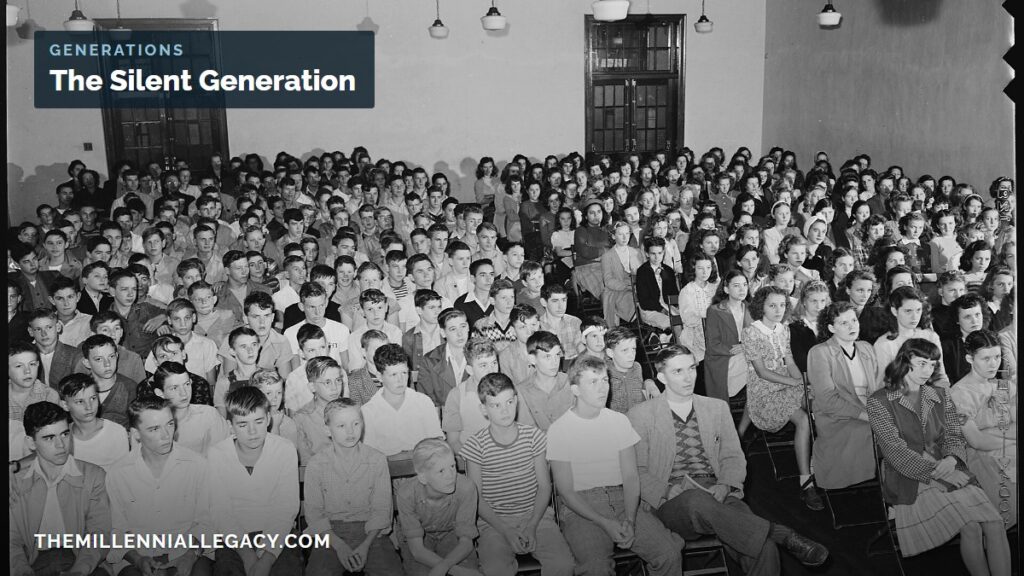
The Silent Generation is made up of Americans born from 1928 to 1945, according to Pew Research Center. They turn 81 to 98 in 2026. By our estimate from Census Bureau data, about 16 million of them were still alive in mid-2024, or roughly 1 in 21 Americans. They were children of the Great Depression and World War II. They got their name from a 1951 TIME essay that found young Americans strikingly quiet.
That quiet image was never the whole story. This generation produced Martin Luther King Jr., Elvis Presley and Ruth Bader Ginsburg. It’s also at the center of a major money shift: in 2026, millennials passed it in total wealth for the first time.
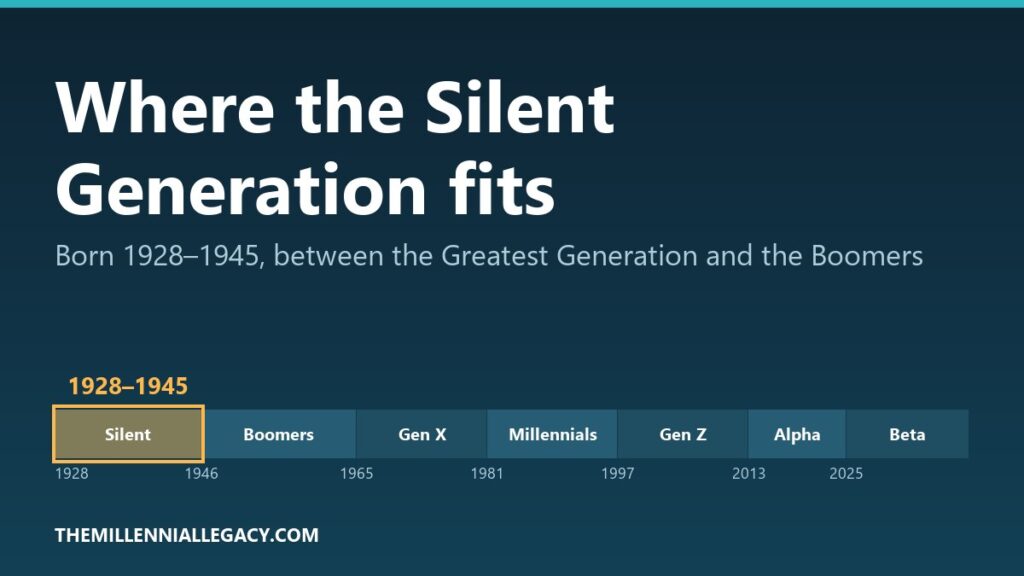
Silent Generation years and age range
The most widely used definition comes from Pew Research Center, which places the Silent Generation between 1928 and 1945. Other sources draw the lines a little differently:
| Source | Silent Generation birth years | Age in 2026 |
|---|---|---|
| Pew Research Center | 1928–1945 | 81–98 |
| Strauss–Howe generational theory (as summarized by TIME) | 1925–1942 | 84–101 |
| Federal Reserve wealth data | Grouped as “Silent and earlier,” born before 1946 | 81+ |
| The original 1951 TIME essay | Described people aged 18 to 28, so born about 1923–1933 | 93–103 |
That last row is a detail most guides miss. The young people TIME first described as silent were older than the group Pew uses today. Most of them are now in their 90s or past 100.
Here’s where the Silent Generation sits in the full lineup:
| Generation | Birth years | Age in 2026 |
|---|---|---|
| Greatest Generation | 1901–1927 | 99+ |
| Silent Generation | 1928–1945 | 81–98 |
| Baby Boomers | 1946–1964 | 62–80 |
| Generation X | 1965–1980 | 46–61 |
| Millennials | 1981–1996 | 30–45 |
Not sure where a birth year lands? Try our generation calculator.
Why is it called the Silent Generation?
On November 5, 1951, TIME ran an essay called “The Younger Generation”. Its reporters had interviewed young people, teachers and parents across the country. Their verdict: “The most startling fact about the younger generation is its silence.”
TIME described young adults who accepted the Korean War draft without protest and wanted steady jobs, early marriage and security. They kept their heads down during the McCarthy era. The essay noted that this generation had already been called “silent,” and the label stuck.
Few people use it about themselves, though. In a 2015 Pew survey, only 18% of Americans born 1928 to 1945 said they belonged to the Silent Generation, and only 27% had heard of the term.
How many Silent Generation members are still alive?
We estimated the size of the generation from the Census Bureau’s single-year-of-age population estimates:
| Date | Americans born 1928–1945 (our estimate) | Share of U.S. population |
|---|---|---|
| July 1, 2020 | about 21.7 million | about 6.5% |
| July 1, 2024 | about 16.1 million | about 4.7% (1 in 21) |
So in four years the generation shrank by about 5.6 million people, a decline of roughly a quarter. Method: we summed the Census Vintage 2024 estimates for the ages that people born in 1928–1945 had reached on each July 1. We counted half of each edge year, since someone born in, say, 1945 could be either of two ages on July 1.
What shaped the Silent Generation
A Depression childhood and a wartime boyhood
The oldest Silents were born just before the 1929 stock market crash. The youngest were born as World War II ended. Birth rates were low during the Depression, so this is a smaller generation than the Boomers who followed. Rationing, scrap drives and fathers or older brothers overseas were part of ordinary childhood.
Coming of age in the 1950s boom
Silents entered adulthood as the postwar economy took off. Many married young, bought homes in new suburbs and worked for one employer for decades, often with a pension at the end. Silent Generation men were the draftees of the Korean War, not World War II.
Not so silent after all
The “silent” label hides how much this group changed the country. Many of the civil rights movement’s leaders were Silents, including Martin Luther King Jr. (born 1929). Rock ‘n’ roll was largely a Silent invention: Little Richard (1932), Elvis Presley (1935) and Buddy Holly (1936). Leaders of the women’s movement, such as Ruth Bader Ginsburg (1933) and Gloria Steinem (1934), were Silents too.
Silent Generation characteristics vs. Baby Boomers
| Silent Generation (1928–1945) | Baby Boomers (1946–1964) | |
|---|---|---|
| Childhood | Depression and World War II | Postwar prosperity, TV, suburbs |
| Defining conflict | Korean War | Vietnam War |
| Attitude toward institutions | Trust, loyalty, working within the system | Questioning authority, protest |
| Typical career | One employer, defined-benefit pension | Job changes; the shift to 401(k)s |
| Generation size | Smaller (Depression birth dip) | Very large (the baby boom) |
| Parenting | Raised most of Generation X | Raised most millennials |
Many Gen Xers were raised by Silent parents, which helps explain Gen X’s famous independence. See our look at parenting styles across generations. The late Boomers who followed are often called Generation Jones.
Famous members of the Silent Generation
- Martin Luther King Jr. (1929)
- Neil Armstrong (1930)
- Warren Buffett (1930)
- Clint Eastwood (1930)
- Ruth Bader Ginsburg (1933)
- Elvis Presley (1935)
- Aretha Franklin (1942)
- Muhammad Ali (1942)
- Joe Biden (1942), the only U.S. president born in the Silent Generation’s years
Donald Trump, born in June 1946, just misses the cutoff and counts as a Baby Boomer. For more on how age groups vote, see generational politics.
The Silent Generation and money: the wealth handoff
In 1989, Americans born before 1946 controlled most of the country’s household wealth. Today they hold about a tenth of it. Here’s the trend in the Federal Reserve’s Distributional Financial Accounts, which group the Silent Generation with earlier generations as “Silent and earlier”:
| Quarter | Silent and earlier | Baby Boomers | Gen X | Millennials and younger (born 1981+) |
|---|---|---|---|---|
| 1989 Q3 | 80.1% | 19.5% | 0.4% | 0% |
| 2000 Q1 | 55.6% | 38.7% | 5.7% | 0% |
| 2010 Q1 | 36.3% | 54.2% | 8.9% | 0.7% |
| 2020 Q1 | 16.1% | 55.0% | 24.7% | 4.2% |
| 2026 Q2 | 10.7% | 52.5% | 25.7% | 11.2% |
Share of total U.S. household net worth. Source: Federal Reserve DFA, our calculation.
The 2026 crossover: in the second quarter of 2026, the Fed’s millennial group (everyone born in 1981 or later, so adult Gen Z too) held $20.8 trillion, passing the Silent and earlier group’s $19.8 trillion for the first time. That group has been catching up fast: it held $11.9 trillion in early 2023. Compare it with our look at wealth across generations.
What families should know now
If you’re helping a Silent Generation parent or grandparent with money, these rules matter most:
- Required minimum distributions: everyone in the Silent Generation is well past the RMD starting age. Withdrawals from traditional IRAs and 401(k)s are required each year, and missing one can trigger a penalty (IRS RMD rules).
- Estate and gift limits: for 2026 the federal estate tax exclusion is $15 million per person, and the annual gift exclusion is $19,000 per recipient (IRS). Most families will never owe federal estate tax, but some states have lower thresholds.
- Inherited IRAs: most adult children who inherit an IRA must empty it within 10 years (IRS beneficiary rules). Plan the withdrawals so they don’t all land in your highest-earning years.
- Scams: Americans 60 and older filed 201,266 complaints with the FBI in 2025 and reported $7.7 billion in losses, up 59% from 2024 (FBI IC3 2025 report). Investment scams accounted for about $3.5 billion of that, and fake tech-support schemes for about $1 billion.
For heirs, the bigger question is what to do with the money. Our guide to average retirement savings by age is a good place to see where you stand first.
General information only, not personalized financial, tax or legal advice. Confirm the rules for your situation with the IRS or a qualified professional.
Silent Generation FAQ
What years are the Silent Generation?
Pew Research Center defines the Silent Generation as Americans born from 1928 to 1945. Some writers use 1925 to 1942 instead.
Why is it called the Silent Generation?
The label took hold after a November 1951 TIME essay described young Americans as quiet, cautious and focused on security rather than protest. The essay called their silence the most startling thing about them.
How old is the Silent Generation in 2026?
Members of the Silent Generation turn 81 to 98 in 2026.
How many members of the Silent Generation are still alive?
About 16 million Americans born from 1928 to 1945 were alive in mid-2024, by our estimate from Census Bureau data. That’s roughly 1 in 21 Americans.
Is Donald Trump a Baby Boomer or Silent Generation?
Donald Trump was born on June 14, 1946, so he’s a Baby Boomer by about five and a half months. Joe Biden, born in 1942, is the only U.S. president from the Silent Generation.
What generation came before the Silent Generation?
The Greatest Generation came before it. Its members were born before 1928, grew up during the Depression and fought or worked through World War II.
Sources
- Pew Research Center – The Whys and Hows of Generations Research (2015)
- Pew Research Center – Most Millennials Resist the ‘Millennial’ Label (2015)
- TIME – People: The Younger Generation (Nov. 5, 1951)
- TIME – How Every Generation of the Last Century Got Its Nickname
- U.S. Census Bureau – National Population by Characteristics, 2020–2024 (single year of age)
- Federal Reserve – Distributional Financial Accounts, wealth by generation (data through 2026:Q2)
- FBI IC3 – 2025 Internet Crime Report (Elder Fraud section)
- IRS – What’s new, estate and gift tax
- IRS – Required minimum distributions (RMDs)
- IRS – Retirement topics, beneficiary