• Skip to primary navigation
  • Skip to main content
  • Skip to primary sidebar

The Millennial Legacy

  • Education
  • Economy
  • Technology
  • Marketing
  • Investing
  • Social
  • Personal Finance
  • Calculator
  • Contact Us

generations

Gen Z vs Gen Alpha: Birth Years, Ages & Real Differences

November 7, 2026 By Emma

Teenagers sitting on a bench, most of them looking at their phones
Photo: Fouquier

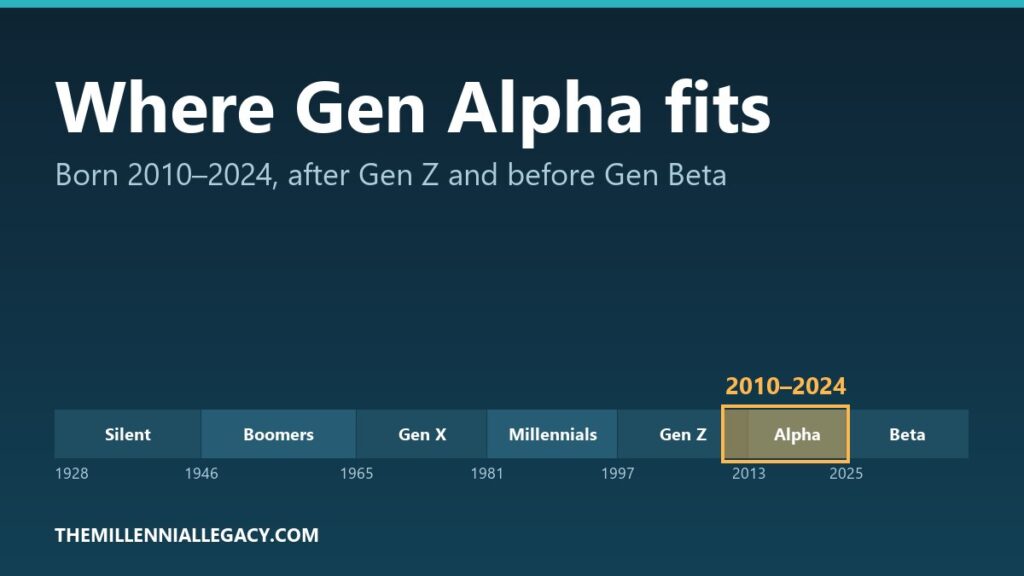
Gen Z vs Gen Alpha starts with a disputed border. Pew Research Center defines Gen Z as everyone born from 1997 to 2012, so in 2026 they turn 14 to 29. Gen Alpha, a name coined by Australian researcher Mark McCrindle, covers kids born from 2010 to 2024, who turn 2 to 16 this year. That leaves three birth years, 2010 to 2012, claimed by both.

In real life, Gen Z now fills high schools, college campuses and entry-level jobs, while Gen Alpha runs from toddlers to high schoolers. Below we sort out the overlap years, then compare the two generations at the same age, using test scores, Census counts and Pew surveys instead of personality stereotypes.
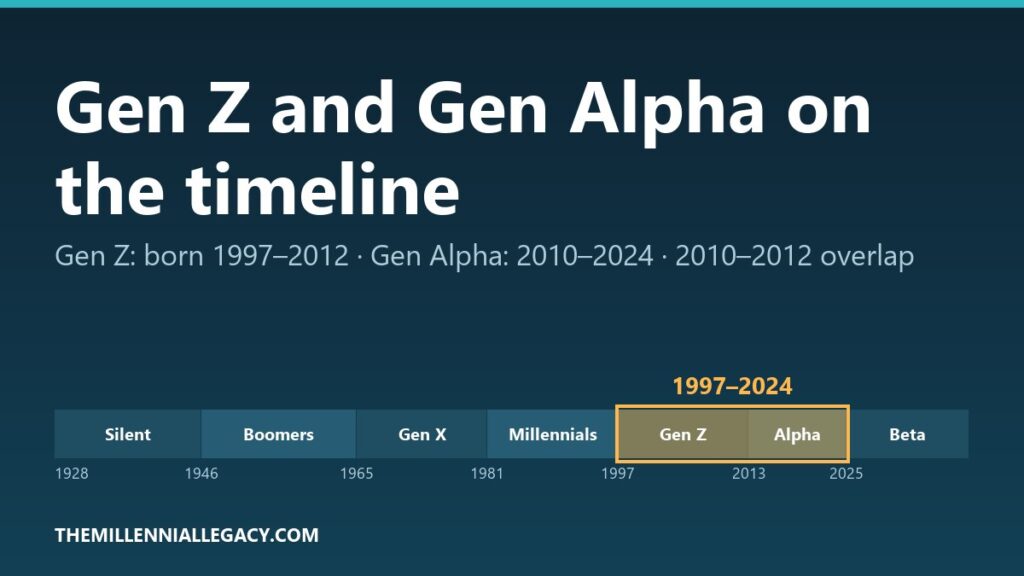
Timeline of US generations highlighting Gen Z, born 1997 to 2012, and Gen Alpha, born 2010 to 2024, with 2010 to 2012 claimed by both

Gen Z vs Gen Alpha at a glance

Gen Z Gen Alpha
Born 1997–2012 (Pew) 2010–2024 (McCrindle)
Age in 2026 14–29 2–16
US population, mid-2024 (our estimate) about 70.6 million about 57.6 million, born through mid-2024
Non-Hispanic white share (our estimate) 49.9% 47.2%
Typically raised by Gen X Millennials
First big screen Smartphones, as teens YouTube and tablets, as babies and toddlers
Hit by COVID-19 The oldest were starting jobs and college The oldest were in elementary school
Came before / after Millennials / Gen Alpha Gen Z / Gen Beta

Method: we added up the Census Bureau’s Vintage 2024 estimates by single year of age for July 1, 2024, counting half of each edge year. Gen Alpha’s count only includes babies born by mid-2024. Want the answer for a specific birth year? Try our generation calculator.

Is 2010, 2011, 2012 or 2013 Gen Z or Gen Alpha?

The overlap comes from two different rulebooks:

  • Pew Research Center set 1996 as the last millennial year and starts Gen Z in 1997, with 2012 as its last year. Pew hasn’t published dates for the generation after Gen Z. In 2023 it went further and said readers shouldn’t expect much new generational research from it at all.
  • McCrindle, the Australian research firm that named Gen Alpha, uses earlier lines: Gen Z from 1995 to 2009 and Gen Alpha from 2010 to 2024. As McCrindle points out, the first Gen Alphas were born in 2010, the year the iPad launched.

Here’s how each cusp year lands:

Born in Turns in 2026 Pew McCrindle Our call
2008 18 Gen Z Gen Z Gen Z
2009 17 Gen Z Gen Z Gen Z
2010 16 Gen Z Gen Alpha Cusp
2011 15 Gen Z Gen Alpha Cusp
2012 14 Gen Z Gen Alpha Cusp
2013 13 After Gen Z Gen Alpha Gen Alpha
2014 12 After Gen Z Gen Alpha Gen Alpha

So is 2012 Gen Z or Gen Alpha? By Pew’s definition, Gen Z. By McCrindle’s, Gen Alpha. Kids born from 2010 to 2012 are a true cusp group, about 12.5 million Americans by our Census count. Like the zillennials between millennials and Gen Z, they can fairly claim either label. In fall 2026, most of them are high school freshmen, sophomores or juniors.

What about a 13-year-old? In 2026, a 13-year-old was born in 2012 or 2013. If 2013, they’re Gen Alpha by every definition. If 2012, it depends on whose definition you use.

Same age, different childhood: the school scorecard

Comparing a 25-year-old with a 10-year-old tells you about age, not generations. Pew makes the same point: generational comparisons only work when you look at each group at a similar stage of life. National test scores let us do that. The Nation’s Report Card (NAEP) tests fourth graders across the country.

  • In 2015, the fourth graders tested were born around 2005. That’s Gen Z by every definition.
  • In 2024, the fourth graders were born around 2014. That’s Gen Alpha by every definition.
NAEP 4th grade, US 2015 (Gen Z) 2024 (Gen Alpha)
Reading, average score 223 215
Reading, below NAEP Basic 31% 40%
Reading, at or above Proficient 36% 31%
Math, average score 240 237
Math, below NAEP Basic 18% 24%
Math, at or above Proficient 40% 39%

Source: NAEP national results for all schools (reading, math); 2015 figures from the NAEP data service, rounded to whole numbers.

At age 9 or 10, Gen Alpha is behind where Gen Z was, especially in reading: 4 in 10 of 2024’s fourth graders read below the Basic level, up from 3 in 10 in 2015. Most of the slide came after 2019. The 2024 fourth graders were in kindergarten when schools closed in spring 2020.

That isn’t a verdict on a generation. Pew warns about “period effects,” events that hit every age group at once, and the pandemic is a textbook case. But it does mean Gen Alpha’s early school years started from a lower baseline than Gen Z’s.

Technology: smartphone teens vs YouTube toddlers

Pew calls Gen Z digital natives with little or no memory of the world before smartphones. Gen Alpha goes a step further: screens arrived before memory did.

Gen Z at 13 to 17: – In 2014–15, when US teens were almost all Gen Z, 73% had or had access to a smartphone, and 24% said they went online “almost constantly” (Pew). – In 2025, the youngest Gen Zers by Pew’s definition (then 13 to 17) had moved on to AI: 64% used chatbots, about 3 in 10 daily, and about 1 in 5 were on TikTok or YouTube almost constantly (Pew).

Gen Alpha at 12 and under (Pew’s 2025 survey of parents): – 85% watch YouTube and 51% watch daily, up from 80% and 43% in 2020. – 62% of kids under 2 watch YouTube, up from 45% in 2020. – 23% have their own smartphone. That rises to about 6 in 10 of 11- and 12-year-olds. – 15% of 11- and 12-year-olds already use AI chatbots, and 37% use TikTok.

Put simply, Gen Z got the smartphone as teenagers. Gen Alpha met YouTube as babies and AI chatbots before middle school. For the creators both groups watch, see our breakdown of the most popular TikTok accounts by generation.

The most diverse generations yet

Pew calls Gen Z more racially and ethnically diverse than any generation before it. Our count of the latest Census estimates shows Gen Alpha going further:

Share of each generation, mid-2024 Millennials Gen Z Gen Alpha
Non-Hispanic white 53.4% 49.9% 47.2%
Hispanic (any race) 21.7% 25.5% 27.0%
Non-Hispanic Black 13.7% 13.6% 13.9%
Non-Hispanic Asian 7.9% 6.1% 6.0%
Two or more races 2.9% 4.9% 6.3%

Our calculation from Census Bureau Vintage 2024 estimates by race, Hispanic origin and single year of age. “Two or more races” includes Hispanic multiracial Americans, so columns don’t add to 100%.

Gen Z sits right at the halfway line. By our count, Gen Alpha is the first generation in which non-Hispanic white Americans are clearly a minority. The fastest-growing group is multiracial: 6.3% of Gen Alpha, more than double the millennial share.

Who’s raising them, and the money they start with

Gen Z is typically the children of Gen X, and Gen Alpha the children of millennials, McCrindle notes. That shift shows up in everything from screen-time rules to parenting styles. Millennial parents are also having fewer kids, later. We dig into that in Millennials, Gen Z and the decline in the US birth rate. For more on the parents themselves, see our guide to the millennial generation.

The money picture is different too:

  • Gen Z took an early hit. In March 2020, half of Gen Zers aged 18 to 23 said they or someone in their household had lost a job or taken a pay cut because of the pandemic, more than any older generation (Pew). If you’re Gen Z and building a cushion now, start with an emergency fund, check savings by age, and weigh a Roth IRA or 401(k).
  • Gen Alpha can get a Trump Account. These new tax-advantaged accounts can be opened for any child under 18 with a Social Security number, and family, employers and others can contribute from July 4, 2026. The $1,000 federal starter deposit only goes to children born from 2025 to 2028, which means Gen Beta, not Gen Alpha (IRS). Millennial parents planning for the long run may also want to read why life insurance in your 30s is worth a look.

Slang, culture and those “traits” lists

Many Gen Z vs Gen Alpha articles list personality traits: Gen Z is anxious, Gen Alpha is impatient, and so on. Take those with a grain of salt. Pew, the source of the most widely used Gen Z definition, says much of the generational content out there is “more like clickbait or marketing mythology.” A typical generation spans 15 to 18 years, and kids born in 2010 and 2024 won’t share a single personality.

Language is where the difference is easy to hear. Gen Alpha’s “6-7” was Dictionary.com’s Word of the Year for 2025. Our Gen Alpha slang guide translates the newest terms.

What comes after Gen Alpha?

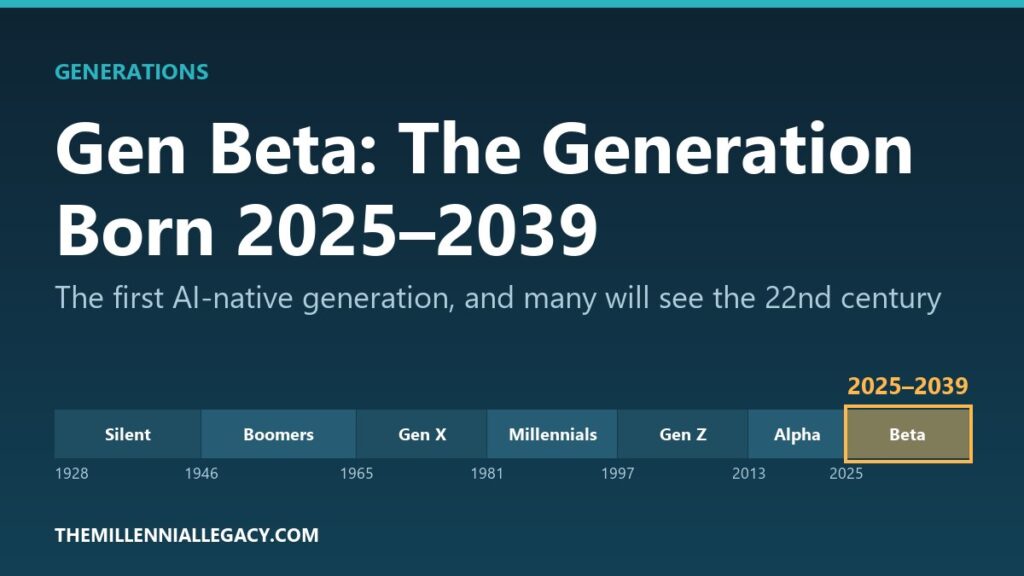
Gen Beta, the kids born from 2025 to 2039. Their parents are mostly younger millennials and the oldest Gen Zers, which means the first Gen Z parents are raising the generation after Gen Alpha.

Not sure where everyone in your family fits? Run each birth year through our generation calculator.

Gen Z vs Gen Alpha FAQ

What years are Gen Z and Gen Alpha?

Pew Research Center defines Gen Z as people born from 1997 to 2012. Gen Alpha, as defined by McCrindle, the researchers who named it, covers kids born from 2010 to 2024. The two definitions overlap for 2010, 2011 and 2012.

Is 2012 Gen Z or Gen Alpha?

Both, depending on who you ask. Pew counts 2012 as the last Gen Z year, while McCrindle counts it as Gen Alpha. Kids born from 2010 to 2012 are on the Gen Z–Gen Alpha cusp. Anyone born in 2013 or later is Gen Alpha by every common definition.

Is a 13-year-old Gen Z or Gen Alpha?

In 2026, a 13-year-old was born in 2012 or 2013. Born in 2013, they’re Gen Alpha by every definition. Born in 2012, they’re Gen Z by Pew’s definition and Gen Alpha by McCrindle’s.

How old is Gen Alpha in 2026?

Gen Alpha turns 2 to 16 in 2026, if you use McCrindle’s 2010–2024 birth years. The oldest are in high school, and the youngest are toddlers.

What is the biggest difference between Gen Z and Gen Alpha?

Timing and technology. Gen Z got smartphones as teenagers. Gen Alpha grew up with YouTube and tablets from babyhood, was in early grades when COVID closed schools, and is mostly being raised by millennials rather than Gen X.

What generation comes after Gen Alpha?

Gen Beta, the kids born from 2025 to 2039. Most of their parents are younger millennials and older Gen Zers.

Sources

  • McCrindle – Generation Alpha defined
  • McCrindle – Gen Z and Gen Alpha infographic update
  • Pew Research Center – Defining generations, where Millennials end and Generation Z begins (2019)
  • Pew Research Center – What we know about Gen Z so far (2020)
  • Pew Research Center – How Pew Research Center will report on generations moving forward (2023)
  • Pew Research Center – Teens, social media and technology overview 2015
  • Pew Research Center – Teens, social media and AI chatbots 2025
  • Pew Research Center – How parents describe their kids’ tech use (2025)
  • The Nation’s Report Card – NAEP 2024 reading, grade 4 national trends
  • The Nation’s Report Card – NAEP 2024 mathematics, grade 4 national trends
  • U.S. Census Bureau – National population by characteristics, 2020–2024 (race and Hispanic origin by single year of age)
  • IRS – Trump Accounts enrollment update
  • Dictionary.com – Word of the Year 2025 (67)
Filed Under: Social Tagged With: Gen Alpha, Gen Z, generations, Parenting

Millennials vs Gen Z: The Real Differences, by the Numbers

November 7, 2026 By Emma

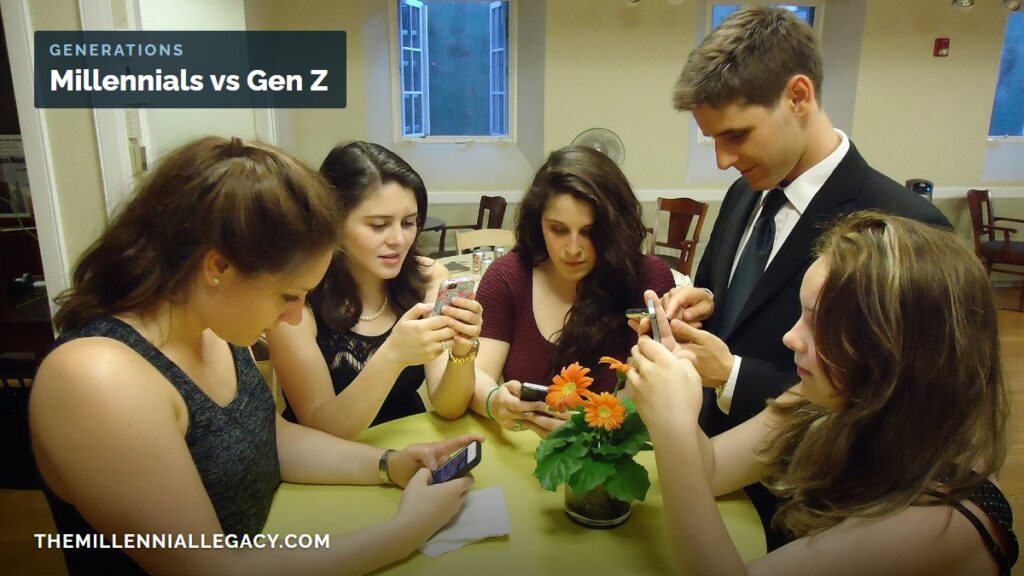
Young adults sitting around a table, each looking at a smartphone
Photo: Tomwsulcer

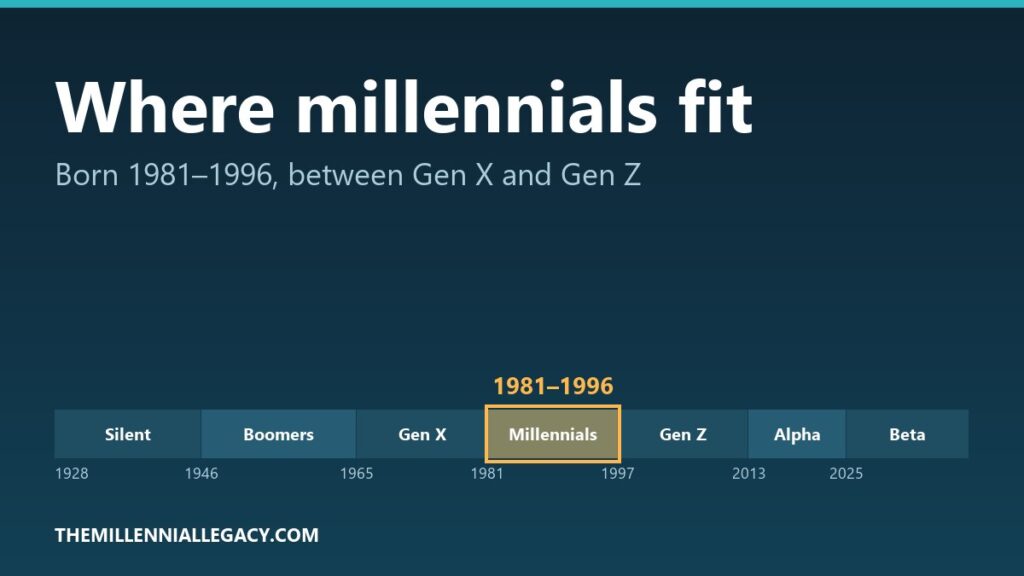
Millennials vs Gen Z comes down to timing. Millennials were born from 1981 to 1996 and turn 30 to 45 in 2026. Gen Z was born from 1997 to 2012 and turns 14 to 29, according to Pew Research Center’s definitions. That makes 2026 a milestone: the youngest millennials turn 30 this year, so by December, for the first time, every American in their 20s is Gen Z.

The memes say millennials love avocado toast and Gen Z can’t make a phone call. The data tells a more useful story. When you compare the two generations at the same age, Gen Z is more likely to be in college and slightly more likely to own a home by 28, but less likely to have a job in their late teens. Here’s how they really compare.

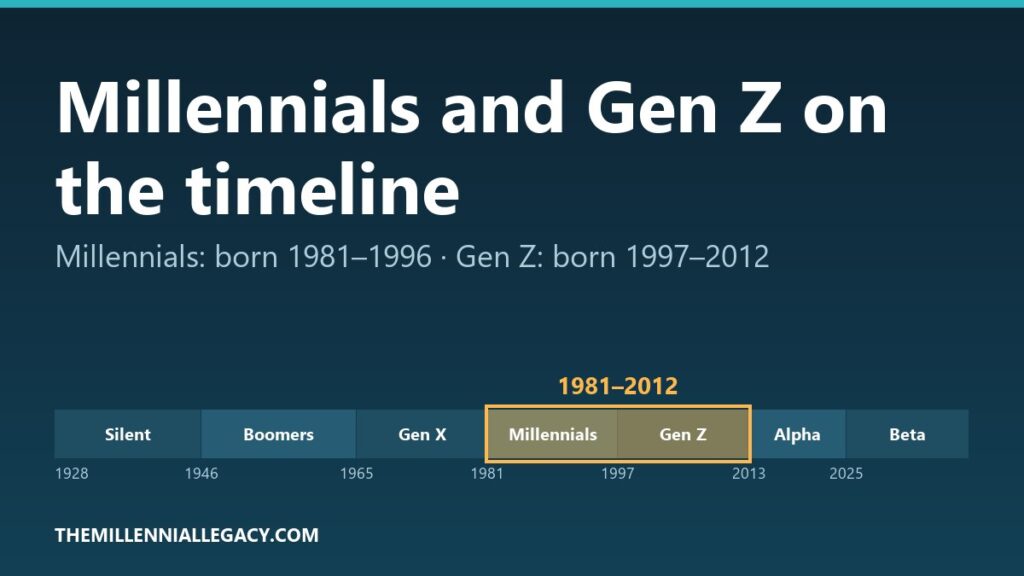
Timeline of US generations highlighting millennials, born 1981 to 1996, and Gen Z, born 1997 to 2012

Millennials vs Gen Z at a glance

Millennials (Gen Y) Gen Z
Born (Pew) 1981–1996 1997–2012
Age in 2026 30–45 14–29
US population, mid-2024 (our estimate) about 74.2 million (21.8%) about 70.6 million (20.8%)
Came before / after Gen X / Gen Z Millennials / Gen Alpha
Came of age with The internet explosion Smartphones and social media from the start
Defining shock The Great Recession, as most entered the workforce COVID-19: the oldest were 23 in 2020
Life stage in 2026 Mid-career High school, college and first jobs

Method: we summed the Census Bureau’s Vintage 2024 single-year-of-age estimates for July 1, 2024, counting half of each edge year. Gen Z’s count includes children as young as 11. Not sure which side you’re on? Try our generation calculator.

Same age, different starting line

Most comparisons put a 25-year-old Gen Zer next to a 40-year-old millennial and call the gap “generational.” That’s mostly just age. A fairer test is to compare each generation at the same age. Pew Research Center did exactly that with Census Bureau data, setting Gen Z in 2017–2018 against millennials at the same ages in 2002. Redfin did the same for homeownership.

Same-age measure Gen Z Millennials Edge
In college (ages 18–20, out of high school) 59% 53% Gen Z
Has a parent with a bachelor’s degree (ages 6–17) 43% 32% Gen Z
Dropped out of high school (ages 18–20) 6% 12% Gen Z
Typical household income growing up (inflation-adjusted) $63,700 $62,400 About even
Worked at some point in the past year (ages 18–21) 58% 72% Millennials
Married (ages 18–21) 4% 7% Gen Z waits longer
Moved in the past year (ages 6–21) 11% 17% Gen Z moves less
Owns a home at age 28 38.3% 36.8% Gen Z, narrowly

Sources: Pew Research Center (Gen Z 2017–2018 vs millennials 2002); Redfin (homeownership, 2025).

Three things stand out:

  • Gen Z is on track to be the best-educated generation. Pew found a higher college enrollment rate and half the dropout rate millennials had at the same age. Their parents are better educated too.
  • Gen Z works later. Only 58% of 18- to 21-year-olds had worked in the previous year, versus 72% of millennials at that age. Pew links this largely to more of them being in college.
  • Homeownership is a near tie, and both trail their parents. At 28, 38.3% of Gen Zers owned their home in 2025, a little ahead of millennials’ 36.8% at that age. Both are behind Gen X (42.5%) and baby boomers (44.4%) at 28.

The events that split them

Pew drew the line at 1996 because of what each group lived through, not because of any single trait.

Moment Millennials Gen Z
9/11 (2001) Most were 5 to 20, many old enough to grasp what it meant Most have little or no memory of it
2008 election Most were 12 to 27, and the youth vote became a story 11 or younger
iPhone launch (2007) Most were teens or young adults The oldest were 10
Great Recession (2007–09) Most came of age and started work as it hit Children

Source: Pew Research Center.

That recession left a mark. Pew notes that the “slow start” shaped millennials’ life choices, future earnings and entry into adulthood in ways that may not apply to Gen Z, and expects the effects to last for decades.

Technology: adapters vs natives

Millennials came of age during the internet explosion. Social media, constant connectivity and on-demand entertainment arrived while they were growing up, and they adapted. For Gen Z, Pew notes, those things have been part of life from the start: by their teens, most young Americans were going online mainly through phones, Wi-Fi and fast cellular service.

Today’s teenagers, the youngest of Gen Z, show where that leads. In Pew’s 2025 survey:

  • About 1 in 5 teens say they’re on TikTok and YouTube “almost constantly.”
  • 64% use AI chatbots, and about 3 in 10 do so daily.
  • Only 31% use Facebook, down from 71% in 2014–15. X (formerly Twitter) is down to 16%.

Gen Z lives on video apps and is first in line for AI tools. See how that plays out on TikTok’s most popular accounts. The slang changes too: compare millennial slang with what Gen Alpha says now.

Views: more alike than the memes suggest

Online, millennials and Gen Z trade insults about skinny jeans and side parts. On the big questions they mostly agree. When Pew surveyed both in 2018, Gen Z’s views looked a lot like millennials’ and differed more from older generations.

Pew survey, 2018 Gen Z Millennials
Same-sex marriage has been good for the country 48% 47%
Black people are treated less fairly than white people 66% 62%
The US is better than all other countries 14% 13%
Know someone who prefers gender-neutral pronouns 35% 25%
Forms should offer gender options besides “man” or “woman” 59% 50%

Source: Pew Research Center. Gen Z was 13 to 21 at the time.

The clearest gap is on gender identity, where Gen Z is more likely to know someone who uses gender-neutral pronouns. On race, marriage and America’s place in the world, the two generations are within a few points of each other.

Work and money

The money gap between the two is mostly an age gap, but both generations face the same obstacle: housing.

  • Homeownership: 55.4% of millennial-led households owned their home in 2025, compared with 27.1% for Gen Z, according to Redfin. The bigger worry is the trend. At 36, 57.2% of millennials own, below Gen X (61.2%) and boomers (63.7%) at that age.
  • First-time buyers are older than ever. The typical first-time buyer is now 40, a record, and first-timers made up just 21% of buyers, also a record low (NAR, 2025). A 40-year-old today is a millennial.
  • Wealth: the Federal Reserve doesn’t track Gen Z separately yet. Its “millennial” group covers everyone born in 1981 or later, adult Gen Z included. That group held about $20.8 trillion, or 11.2% of US household wealth, in mid-2026, up from 4.0% at the end of 2019, by our calculation from the Fed’s Distributional Financial Accounts. In that quarter it passed the Silent Generation and older Americans for the first time.
  • Work: Gen Z starts working later, mostly because more of them are in school. For how side gigs fit into both generations’ careers, see our look at the gig economy.

What it means for your money at each stage:

  • Gen Z (14–29): build the basics first: an emergency fund, renters insurance, and a healthy skepticism of money advice on TikTok.
  • Millennials (30–45): this is the catch-up decade. Check yourself against savings by age and retirement savings by age, and decide between a Roth IRA and a 401(k).

Born on the line? Zillennials and cusp years

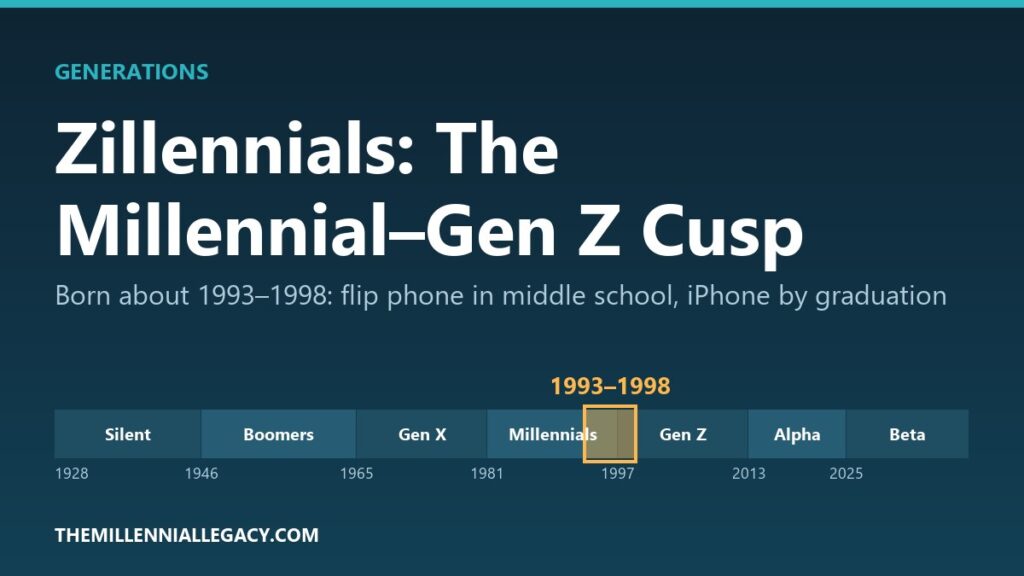
Generations don’t flip overnight on January 1, 1997. Even Pew says generational cutoff points “aren’t an exact science.” People born from roughly 1993 to 1998 often say they don’t fit either label, and many call themselves zillennials.

The same blur happens at the other end. Many of the oldest millennials, born around 1981, relate more to Gen X. Today’s kids, Gen Alpha and the babies of Gen Beta, are mostly being raised by millennials and older Gen Zers. For the full picture of the older group, read our guide to the millennial generation.

Millennials vs Gen Z FAQ

What years are millennials and Gen Z?

Pew Research Center defines millennials as people born from 1981 to 1996 and Gen Z as people born from 1997 to 2012. Other researchers shift the line by a year or two, but Pew’s 1996/1997 cutoff is the one most often cited.

How old are millennials and Gen Z in 2026?

Millennials turn 30 to 45 in 2026, and Gen Z turns 14 to 29. By the end of 2026, for the first time, no millennial is in their 20s.

Am I a millennial or Gen Z if I was born in 1996 or 1997?

By Pew’s definition, 1996 is the last millennial year and 1997 is the first Gen Z year. People born from about 1993 to 1998 often feel like neither, and many call themselves zillennials.

What is the biggest difference between millennials and Gen Z?

Timing. Millennials adapted to smartphones and social media as teens or adults, and many started work during the Great Recession. Gen Z never knew life without them. At the same age, Gen Z is more likely to be in college and less likely to have a job.

Which generation is bigger, millennials or Gen Z?

Millennials, for now. By our estimate from Census Bureau data, there were about 74.2 million millennials and 70.6 million Gen Zers in the US in mid-2024. Both groups grew from 2020 to 2024 as young immigrants arrived.

Is Gen Y the same as millennials?

Yes. Gen Y and millennials are two names for the same generation, the one that came after Gen X and before Gen Z.

Sources

  • Pew Research Center – Defining generations, where Millennials end and Generation Z begins (2019)
  • Pew Research Center – Early benchmarks show post-Millennials on track to be most diverse, best-educated generation yet (2018)
  • Pew Research Center – Generation Z looks a lot like Millennials on key social and political issues (2019)
  • Pew Research Center – Teens, social media and AI chatbots 2025
  • Redfin – Homeownership rate by generation, 2025
  • NAR – First-time home buyer share falls to historic low of 21%, median age rises to 40 (Nov. 4, 2025)
  • Federal Reserve – Distributional Financial Accounts, wealth by generation (data through 2026:Q2)
  • U.S. Census Bureau – National population by characteristics, 2020–2024 (single year of age)

Filed Under: Social Tagged With: Gen Z, generations, millennials

Gen Alpha Slang 2026: The Most-Searched Terms, Decoded

November 6, 2026 By Emma

Middle schoolers working on tablets around a classroom table
Photo: Ronja Aigner and Michelle Kohlmeier

Gen Alpha slang is the vocabulary of kids born from 2010 to 2024, who are 2 to 16 years old in 2026. The term parents look up most, by a wide margin, is 6-7: about 1.4 million searches a month in the U.S., more than the next ten terms combined. After that come chud, sybau, mogging, bussin, huzz and rizz. Some of these are harmless nonsense. A few are crude, and a few come from corners of the internet you’ll want to know about.

Below are the 40-odd terms you’re most likely to hear, ranked by how often Americans search for their meaning. Each one has a plain-English definition, and many have a millennial translation. There’s a short heads-up list for parents at the end.

Timeline of US generations highlighting Gen Alpha, born 2010 to 2024

The most-searched Gen Alpha slang terms (2026)

We pulled monthly U.S. search volumes from Ahrefs for “[term] meaning” and “what does [term] mean,” plus common spellings, and added them up. A big search number doesn’t mean kids use a word the most. It means the most adults (and kids) are confused by it.

Rank Term What it means U.S. searches a month for its meaning
1 6-7 (six seven, 67) Nonsense phrase shouted as an inside joke about 1,416,000
2 chud Insult for an unpleasant, often right-wing, man about 309,000
3 sybau Crude way to say “shut up” about 128,000
4 mogging (mog, mogged) Outshining someone, especially in looks about 126,000
5 bussin Really good, usually food about 43,000
6 huzz Girls or women; often derogatory about 42,000
7 rizz Charm, flirting skill about 41,000
8 skibidi Cool, bad, or nothing at all about 39,000
9 sigma A cool loner who doesn’t follow the crowd about 38,000
10 icl “I can’t lie” (texting) about 35,000
11 quiet on the creek Keep it secret about 35,000
12 pookie Affectionate name for a friend or partner about 28,000
13 no cap No lie, for real about 28,000
14 gyatt Reaction to someone’s curvy body about 27,000
15 crash out Lose control and do something reckless about 26,000

Source: Ahrefs Keywords Explorer, U.S. average monthly volume, pulled November 6, 2026; our sums across phrasings. We left out words with big non-slang meanings, such as aura, NPC, LARP, based and nonchalant, because we can’t separate slang searches from ordinary ones.

Just below the top 15: maxxing (21,000), jit (21,000), clock it (21,000), opp (21,000), big back (19,000) and unc (17,000).

The 6-7 number is striking. Dictionary.com, which named it the 2025 Word of the Year, reported that searches rose more than sixfold after June 2025. A year later, Americans still look it up roughly 1.4 million times a month.

Gen Alpha slang list: what each term means

Nonsense and meme words

These mostly mean nothing. They’re inside jokes, and saying them is the point.

  • 6-7 (six seven): Shouted at random, often with both palms up, moving like a scale. It can mean “so-so” or “maybe this, maybe that.” It’s usually traced to the song “Doot Doot (6 7)” by Philly rapper Skrilla, and basketball clips helped it spread (NBA player LaMelo Ball is 6-foot-7). Math teachers say they can’t get through a class without someone yelling it, and some have banned it in their classrooms. A linguist told CNN that it works as a shibboleth, a password that shows you’re in the group.
  • Skibidi: From the YouTube series Skibidi Toilet. Cambridge Dictionary added it in 2025 and says it can mean “cool,” “bad,” or nothing at all.
  • Ohio: Weird or cringe, as in “only in Ohio.” It has nothing to do with the state.
  • Italian brainrot: AI-generated cartoon characters with fake-Italian names, such as Tralalero Tralala and Tung Tung Tung Sahur.
  • Brainrot: Both the silly content itself and what it supposedly does to your brain.

Compliments and approval

  • Rizz: Charm, especially flirting skill. Someone with lots of it is a “rizzler.”
  • Bussin: Really good, usually about food.
  • Ate (or “ate and left no crumbs”): Did something perfectly.
  • Tuff: Cool or impressive.
  • Aura: Someone’s coolness. Doing something embarrassing costs “aura points.” Aura farming means acting cool on purpose for the camera.
  • Sigma: A cool loner who doesn’t care what others think. Kids mostly use it as a joke, but see the parent section below for where it comes from.
  • Based: Admirably unbothered by what others think.
  • Pookie: A sweet name for a friend or partner.

Insults and put-downs

  • Mid: Mediocre, disappointing.
  • Chopped: Ugly or unappealing.
  • Cooked: Doomed, out of luck. “If the teacher checks, we’re cooked.”
  • Glazing: Over-the-top praise; sucking up. “Stop glazing him.”
  • NPC: Someone who acts like a background character in a video game, with no original thoughts.
  • Unc: An older person who’s out of touch, from “uncle.” It made Dictionary.com’s 2026 shortlist. If you’re a millennial, this one is probably about you.
  • Clanker: An insult for robots and AI, borrowed from Star Wars.
  • Chud: An unpleasant, uncool or bigoted man. Online, it’s mostly aimed at right-wing men.
  • LARP / larping: Pretending to be something you’re not, from live-action role-playing.

Everyday phrases

  • No cap / cap: “No cap” means “no lie.” “Cap” means a lie.
  • Icl / ong / fr: “I can’t lie,” “on God” and “for real.” All three mean “honestly.”
  • Lock in: Focus hard. “I have to lock in for this test.”
  • Crash out: Lose control and make a bad decision, usually out of anger.
  • Clock it: Notice something, or call someone out. “She clocked it immediately.”
  • Delulu: Cambridge defines it as believing things that aren’t true, usually because you choose to. It’s sometimes used proudly about big dreams.
  • Quiet on the creek: Keep it secret. It comes from a Saucy Santana livestream, according to Mental Floss.
  • Crine: A deliberate misspelling of “crying,” meaning something is extremely funny.
  • Fanum tax: Taking a bite of a friend’s food, named after the streamer Fanum.
  • Jit: A younger kid.
  • Opp: An opponent or enemy. It started as gang slang.

New Gen Alpha slang in 2026: maxxing and mogging

Two words got the dictionary treatment this fall, and both started in the same place.

Maxxing is Dictionary.com’s 2026 Word of the Year. It means pushing something to the max or optimizing one part of your life: sleepmaxxing, looksmaxxing or even nothingmaxxing, a joke about rejecting the pressure to optimize at all.

Mogging is Collins Dictionary’s 2026 Word of the Year. Collins said the word saw a 210% increase in usage this year. To mog someone is to outshine them, usually in looks. “Framemogging” means looking much bigger or more muscular.

Both terms came out of the “looksmaxxing” world, a subculture that grew from incel message boards and treats appearance as destiny. NPR reports that “mog” likely comes from AMOG, or “alpha male of the group.” Most kids who say “he mogged me” today mean it as a joke. That’s worth knowing, and it isn’t a reason to panic.

Gen Alpha slang translated into millennial

If you grew up with AIM away messages, here’s your translation guide.

Gen Alpha says A millennial would have said
rizz game (“he’s got game”)
mid meh
cooked toast
aura swag
no cap for real, legit
bussin the bomb
ate nailed it, killed it
glazing brown-nosing
crash out flip out, lose it
mogging showing someone up
delulu living in a dream world
sigma lone wolf
NPC sheeple
lock in get in the zone
clock it called it
fanum tax “dibs on your fries”
unc old head
skibidi, 6-7 “random!”, or “you just lost The Game”

The last row is the most important one. Every generation has had words that mean nothing on purpose. The joke is that adults don’t get it. For the slang millennials actually used, see our guide to millennial slang.

Gen Z vs. Gen Alpha slang: where the words come from

Most “Gen Alpha slang” isn’t new. A lot of it came from Gen Z, and Gen Z got much of its slang from African American Vernacular English (AAVE) and hip-hop: no cap, bussin, opp, jit, unc. Gaming added NPC, aura points and lock in. Livestreamers added gyatt, fanum tax and huzz.

What’s more distinctly Gen Alpha is the absurd layer: skibidi, 6-7, Ohio, Italian brainrot. These spread through YouTube Shorts, Roblox and school hallways rather than through texting. They also burn out fast. Once parents and teachers start saying a word, it’s usually on its way out.

Gen Alpha’s oldest members turned 16 this year, and its youngest were born in 2024. For how they compare with Gen Z beyond slang, see Gen Z vs Gen Alpha. The next group, Gen Beta, is still in diapers. Not sure which generation your family members fall into? Use our generation calculator.

What parents should know

Most of this is harmless. A handful of terms are worth a second look:

  • Crude or sexual: sybau is short for a vulgar “shut up.” Gyatt is an exclamation about someone’s body, usually their backside. Huzz comes from “hoes” and usually refers to girls. Bop and bird are put-downs aimed at girls.
  • From the manosphere: sigma, alpha and beta, mogging, looksmaxxing and mewing (pressing your tongue to the roof of your mouth for a sharper jaw) all came out of online spaces built around male status and looks. Experts in NPR’s guide for parents suggest approaching boys with genuine curiosity and taking an interest in what they watch and play.
  • Context matters: chud and opp can be playful or hostile depending on who’s saying them and to whom.

A calm “what does that mean?” usually gets a better answer than a lecture. It also tells you which apps and creators your kid is watching. Those feeds teach kids about money too, so it’s worth knowing who the top finfluencers on TikTok are. For how other generations approached this, see parenting styles across generations.

We update this page every month as new terms appear and old ones fade. Last checked: November 6, 2026.

Gen Alpha Slang FAQ

What is Gen Alpha slang?

Gen Alpha slang is the vocabulary used by kids born from 2010 to 2024, who are 2 to 16 years old in 2026. Much of it is borrowed from Gen Z, African American Vernacular English, gaming and livestreamers. Some of it, like 6-7, is deliberate nonsense.

What does 6-7 mean?

Nothing fixed, and that’s the point. Kids shout “six seven,” often with a palms-up juggling gesture, as an inside joke. It can mean “so-so” or “maybe this, maybe that.” It comes from Skrilla’s song “Doot Doot (6 7)” and was Dictionary.com’s 2025 Word of the Year.

What does mogging mean?

Mogging means outshining someone, especially in looks or presence. “He mogged everyone in the group photo.” The word started in online communities obsessed with male status. Teens now mostly use it as a joke. Collins Dictionary named it the 2026 Word of the Year.

What is the newest Gen Alpha slang in 2026?

Terms that took off in 2026 include maxxing (Dictionary.com’s Word of the Year), mogging (Collins’ pick), unc, clanker, crine and “quiet on the creek.” Older terms like rizz, skibidi and 6-7 are still in heavy use.

What’s the difference between Gen Z and Gen Alpha slang?

There’s a lot of overlap. Gen Z popularized terms like no cap, bussin, slay and rizz, and Gen Alpha inherited them. What’s more distinctly Gen Alpha is the absurd, meme-driven layer, such as skibidi, 6-7, Ohio and Italian brainrot, which spreads through YouTube Shorts and Roblox.

Should I use Gen Alpha slang with my kids?

Sparingly, if at all. Kids often drop a term once adults start using it, and an adult saying “6-7” is usually a joke in itself. Knowing what the words mean matters more than using them.

Sources

  • McCrindle – Generation Alpha defined
  • Ahrefs Keywords Explorer – US monthly search volumes for “[term] meaning” and “what does [term] mean” (pulled 2026-11-06)
  • Dictionary.com – Word of the Year 2025 (67)
  • Dictionary.com – Word of the Year 2026 (maxxing)
  • CNN – ‘Mogging’ is Collins’ word of the year (Nov. 3, 2026)
  • NPR – ‘Mogging,’ rooted in the manosphere, found new life as a joke (Apr. 3, 2026)
  • NPR – What is looksmaxxing? How parents can talk to their sons about it (May 1, 2026)
  • NPR – Why the numbers 6-7 are driving math teachers up the wall (Oct. 19, 2025)
  • CNN – The ‘6-7’ meme can be annoying. But kids are shouting it for good reason (Oct. 18, 2025)
  • Cambridge Dictionary – skibidi
  • Cambridge Dictionary – delulu
  • Mental Floss – The Top 24 Gen Alpha Slang Terms of 2026 (Sep. 2026)

Filed Under: Social Tagged With: Gen Alpha, Gen Z, generations, Parenting, slang

Silent Generation (1928–1945): Years, Meaning & Facts

November 6, 2026 By Emma

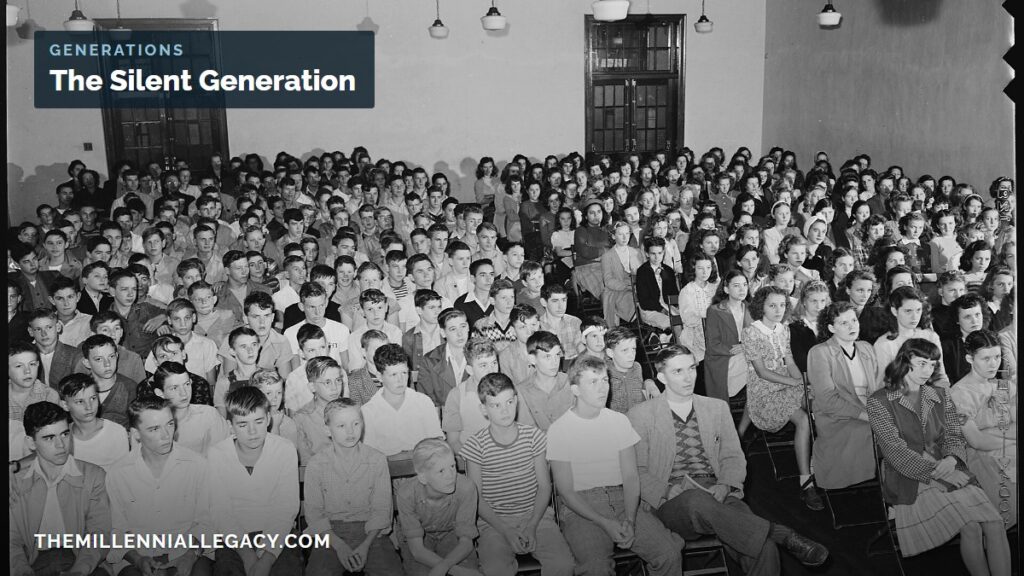
High school students seated in a packed auditorium in 1946
Photo: Russell Lee, National Archives

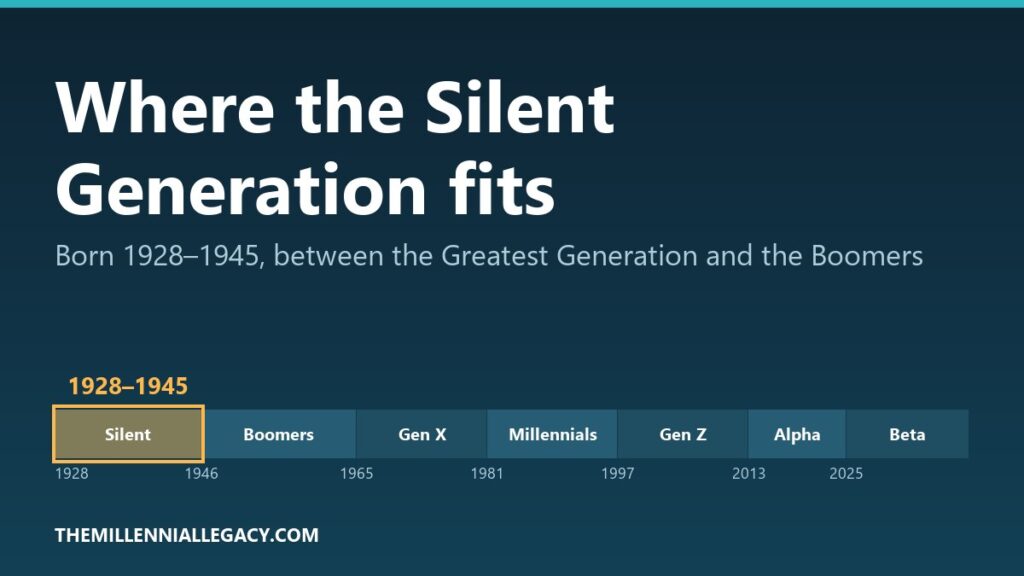
The Silent Generation is made up of Americans born from 1928 to 1945, according to Pew Research Center. They turn 81 to 98 in 2026. By our estimate from Census Bureau data, about 16 million of them were still alive in mid-2024, or roughly 1 in 21 Americans. They were children of the Great Depression and World War II. They got their name from a 1951 TIME essay that found young Americans strikingly quiet.

That quiet image was never the whole story. This generation produced Martin Luther King Jr., Elvis Presley and Ruth Bader Ginsburg. It’s also at the center of a major money shift: in 2026, millennials passed it in total wealth for the first time.

Timeline of US generations highlighting the Silent Generation, born 1928 to 1945

Silent Generation years and age range

The most widely used definition comes from Pew Research Center, which places the Silent Generation between 1928 and 1945. Other sources draw the lines a little differently:

Source Silent Generation birth years Age in 2026
Pew Research Center 1928–1945 81–98
Strauss–Howe generational theory (as summarized by TIME) 1925–1942 84–101
Federal Reserve wealth data Grouped as “Silent and earlier,” born before 1946 81+
The original 1951 TIME essay Described people aged 18 to 28, so born about 1923–1933 93–103

That last row is a detail most guides miss. The young people TIME first described as silent were older than the group Pew uses today. Most of them are now in their 90s or past 100.

Here’s where the Silent Generation sits in the full lineup:

Generation Birth years Age in 2026
Greatest Generation 1901–1927 99+
Silent Generation 1928–1945 81–98
Baby Boomers 1946–1964 62–80
Generation X 1965–1980 46–61
Millennials 1981–1996 30–45

Not sure where a birth year lands? Try our generation calculator.

Why is it called the Silent Generation?

On November 5, 1951, TIME ran an essay called “The Younger Generation”. Its reporters had interviewed young people, teachers and parents across the country. Their verdict: “The most startling fact about the younger generation is its silence.”

TIME described young adults who accepted the Korean War draft without protest and wanted steady jobs, early marriage and security. They kept their heads down during the McCarthy era. The essay noted that this generation had already been called “silent,” and the label stuck.

Few people use it about themselves, though. In a 2015 Pew survey, only 18% of Americans born 1928 to 1945 said they belonged to the Silent Generation, and only 27% had heard of the term.

How many Silent Generation members are still alive?

We estimated the size of the generation from the Census Bureau’s single-year-of-age population estimates:

Date Americans born 1928–1945 (our estimate) Share of U.S. population
July 1, 2020 about 21.7 million about 6.5%
July 1, 2024 about 16.1 million about 4.7% (1 in 21)

So in four years the generation shrank by about 5.6 million people, a decline of roughly a quarter. Method: we summed the Census Vintage 2024 estimates for the ages that people born in 1928–1945 had reached on each July 1. We counted half of each edge year, since someone born in, say, 1945 could be either of two ages on July 1.

What shaped the Silent Generation

A Depression childhood and a wartime boyhood

The oldest Silents were born just before the 1929 stock market crash. The youngest were born as World War II ended. Birth rates were low during the Depression, so this is a smaller generation than the Boomers who followed. Rationing, scrap drives and fathers or older brothers overseas were part of ordinary childhood.

Coming of age in the 1950s boom

Silents entered adulthood as the postwar economy took off. Many married young, bought homes in new suburbs and worked for one employer for decades, often with a pension at the end. Silent Generation men were the draftees of the Korean War, not World War II.

Not so silent after all

The “silent” label hides how much this group changed the country. Many of the civil rights movement’s leaders were Silents, including Martin Luther King Jr. (born 1929). Rock ‘n’ roll was largely a Silent invention: Little Richard (1932), Elvis Presley (1935) and Buddy Holly (1936). Leaders of the women’s movement, such as Ruth Bader Ginsburg (1933) and Gloria Steinem (1934), were Silents too.

Silent Generation characteristics vs. Baby Boomers

Silent Generation (1928–1945) Baby Boomers (1946–1964)
Childhood Depression and World War II Postwar prosperity, TV, suburbs
Defining conflict Korean War Vietnam War
Attitude toward institutions Trust, loyalty, working within the system Questioning authority, protest
Typical career One employer, defined-benefit pension Job changes; the shift to 401(k)s
Generation size Smaller (Depression birth dip) Very large (the baby boom)
Parenting Raised most of Generation X Raised most millennials

Many Gen Xers were raised by Silent parents, which helps explain Gen X’s famous independence. See our look at parenting styles across generations. The late Boomers who followed are often called Generation Jones.

Famous members of the Silent Generation

  • Martin Luther King Jr. (1929)
  • Neil Armstrong (1930)
  • Warren Buffett (1930)
  • Clint Eastwood (1930)
  • Ruth Bader Ginsburg (1933)
  • Elvis Presley (1935)
  • Aretha Franklin (1942)
  • Muhammad Ali (1942)
  • Joe Biden (1942), the only U.S. president born in the Silent Generation’s years

Donald Trump, born in June 1946, just misses the cutoff and counts as a Baby Boomer. For more on how age groups vote, see generational politics.

The Silent Generation and money: the wealth handoff

In 1989, Americans born before 1946 controlled most of the country’s household wealth. Today they hold about a tenth of it. Here’s the trend in the Federal Reserve’s Distributional Financial Accounts, which group the Silent Generation with earlier generations as “Silent and earlier”:

Quarter Silent and earlier Baby Boomers Gen X Millennials and younger (born 1981+)
1989 Q3 80.1% 19.5% 0.4% 0%
2000 Q1 55.6% 38.7% 5.7% 0%
2010 Q1 36.3% 54.2% 8.9% 0.7%
2020 Q1 16.1% 55.0% 24.7% 4.2%
2026 Q2 10.7% 52.5% 25.7% 11.2%

Share of total U.S. household net worth. Source: Federal Reserve DFA, our calculation.

The 2026 crossover: in the second quarter of 2026, the Fed’s millennial group (everyone born in 1981 or later, so adult Gen Z too) held $20.8 trillion, passing the Silent and earlier group’s $19.8 trillion for the first time. That group has been catching up fast: it held $11.9 trillion in early 2023. Compare it with our look at wealth across generations.

What families should know now

If you’re helping a Silent Generation parent or grandparent with money, these rules matter most:

  • Required minimum distributions: everyone in the Silent Generation is well past the RMD starting age. Withdrawals from traditional IRAs and 401(k)s are required each year, and missing one can trigger a penalty (IRS RMD rules).
  • Estate and gift limits: for 2026 the federal estate tax exclusion is $15 million per person, and the annual gift exclusion is $19,000 per recipient (IRS). Most families will never owe federal estate tax, but some states have lower thresholds.
  • Inherited IRAs: most adult children who inherit an IRA must empty it within 10 years (IRS beneficiary rules). Plan the withdrawals so they don’t all land in your highest-earning years.
  • Scams: Americans 60 and older filed 201,266 complaints with the FBI in 2025 and reported $7.7 billion in losses, up 59% from 2024 (FBI IC3 2025 report). Investment scams accounted for about $3.5 billion of that, and fake tech-support schemes for about $1 billion.

For heirs, the bigger question is what to do with the money. Our guide to average retirement savings by age is a good place to see where you stand first.

General information only, not personalized financial, tax or legal advice. Confirm the rules for your situation with the IRS or a qualified professional.

Silent Generation FAQ

What years are the Silent Generation?

Pew Research Center defines the Silent Generation as Americans born from 1928 to 1945. Some writers use 1925 to 1942 instead.

Why is it called the Silent Generation?

The label took hold after a November 1951 TIME essay described young Americans as quiet, cautious and focused on security rather than protest. The essay called their silence the most startling thing about them.

How old is the Silent Generation in 2026?

Members of the Silent Generation turn 81 to 98 in 2026.

How many members of the Silent Generation are still alive?

About 16 million Americans born from 1928 to 1945 were alive in mid-2024, by our estimate from Census Bureau data. That’s roughly 1 in 21 Americans.

Is Donald Trump a Baby Boomer or Silent Generation?

Donald Trump was born on June 14, 1946, so he’s a Baby Boomer by about five and a half months. Joe Biden, born in 1942, is the only U.S. president from the Silent Generation.

What generation came before the Silent Generation?

The Greatest Generation came before it. Its members were born before 1928, grew up during the Depression and fought or worked through World War II.

Sources

  • Pew Research Center – The Whys and Hows of Generations Research (2015)
  • Pew Research Center – Most Millennials Resist the ‘Millennial’ Label (2015)
  • TIME – People: The Younger Generation (Nov. 5, 1951)
  • TIME – How Every Generation of the Last Century Got Its Nickname
  • U.S. Census Bureau – National Population by Characteristics, 2020–2024 (single year of age)
  • Federal Reserve – Distributional Financial Accounts, wealth by generation (data through 2026:Q2)
  • FBI IC3 – 2025 Internet Crime Report (Elder Fraud section)
  • IRS – What’s new, estate and gift tax
  • IRS – Required minimum distributions (RMDs)
  • IRS – Retirement topics, beneficiary

Filed Under: Social Tagged With: baby boomers, generations, Silent Generation, wealth

Generation Jones (1954–1965): Meaning, Traits & Retirement

November 5, 2026 By Oliver

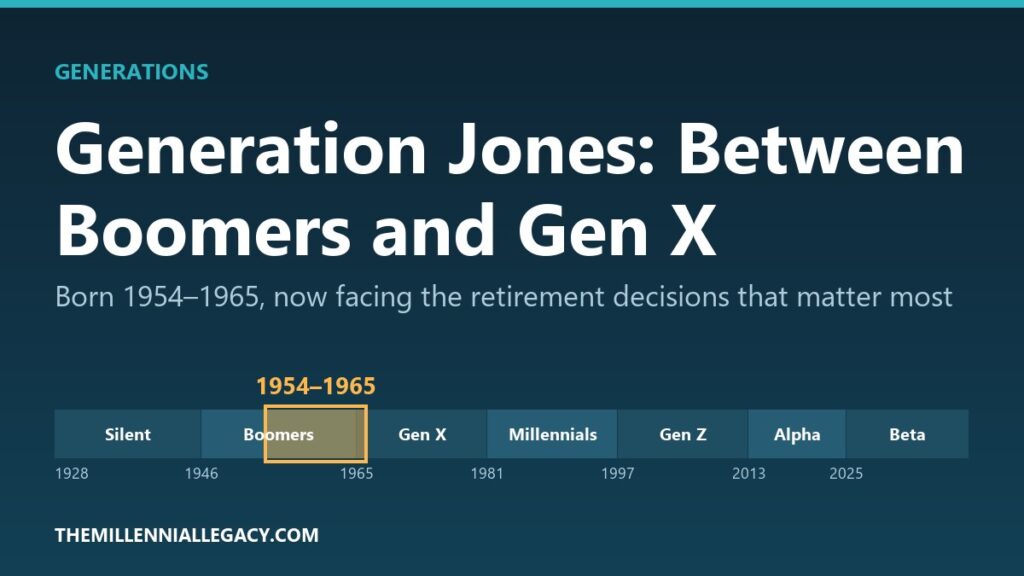
Generation Jones, born 1954 to 1965

Born in the late ’50s or early ’60s? You’ve probably been called a Baby Boomer your whole life, and it never quite fit.

You were too young for Woodstock and too old for MTV’s grunge era. By the time you entered the job market, the post-war boom was over and the 1970s gas lines had arrived. There’s a name for your group: Generation Jones.

What is Generation Jones?

Generation Jones refers to people born roughly 1954 to 1965. That’s the second half of the Baby Boom, and it overlaps with what some people call “late boomers.” Writer and cultural commentator Jonathan Pontell coined the term. He argued that this group had a different formative experience from the older boomers of the 1940s and early ’50s.

The name works on two levels:

  • “Keeping up with the Joneses.” They were a huge, anonymous cohort competing for jobs, homes and status.
  • “Jonesing.” That’s slang for craving something. Pontell’s point: this generation grew up promised the idealistic, prosperous future the older boomers got, and spent years jonesing for it.

Generation Jones years and ages

Generation Birth years Age in 2026
Silent Generation 1928–1945 81–98
Baby Boomers (core / “Boomer I”) 1946–1954 72–80
Generation Jones (“Boomer II”) 1954–1965 61–72
Generation X 1965–1980 46–61
Xennials (cusp) 1977–1983 43–49

Most official sources, including Pew Research and the U.S. Census Bureau, still lump everyone born from 1946 to 1964 together as Baby Boomers. Generation Jones is a sub-generation, not a replacement. Check where your year lands with our generation calculator.

Why Generation Jones isn’t “just boomers”

Being born 10 to 15 years apart makes a big difference when history moves fast. Here’s how the two halves of the boom compare:

Early Boomers (1946–1954) Generation Jones (1954–1965)
Coming-of-age events JFK, civil rights movement, Vietnam draft, Woodstock Watergate, end of Vietnam, 1973 oil crisis, Iran hostage crisis
Economy when entering work Post-war expansion, plentiful jobs Stagflation, high inflation, early-’80s recession
Mood Idealism, protest, “we can change the world” Cynicism, pragmatism, “make it on your own”
Housing Bought homes when they were cheap Faced mortgage rates near 18% in the early ’80s
Music on the radio as teens Beatles, Motown, folk rock Disco, punk, early hip-hop, new wave

What shaped Generation Jones

Broken promises of the ’70s

Joneses were kids during the optimism of the 1960s. They became teens and young adults in a decade of Watergate, gas lines and double-digit inflation. That gap between what they were promised and what they got is the core of the “jonesing” idea.

The first workers of the modern economy

Jonesers saw pensions start giving way to 401(k)s. The 401(k) itself dates to a 1978 law, and employers adopted it widely in the early 1980s. Many Jonesers were among the first to manage their own retirement investing.

Tech adopters, not natives

They grew up with TV and vinyl. As adults, they adopted personal computers, email and cell phones. That adaptability shows up today: plenty of 60-somethings are more online than their kids give them credit for.

Political swing voters

Pundits have long called Generation Jones a swing generation in elections. The group includes high-profile leaders on both sides of the aisle. More in our piece on generational politics.

Famous members of Generation Jones

  • Oprah Winfrey (1954)
  • Tom Hanks (1956)
  • Madonna (1958)
  • Barack Obama (1961)
  • Michael Jordan (1963)
  • Michelle Obama (1964)

Generation Jones and retirement: the rules that apply to you now

Gen Jones is now 61 to 72, so it’s squarely in the retirement decision zone. The rules differ depending on birth year, and Gen Jones straddles several cutoffs.

Social Security full retirement age

Full retirement age depends on your birth year (SSA schedule):

Birth year Full retirement age (FRA)
1954 66
1955 66 and 2 months
1956 66 and 4 months
1957 66 and 6 months
1958 66 and 8 months
1959 66 and 10 months
1960–1965 67

You can claim as early as 62 with a permanent reduction. Waiting past FRA up to age 70 earns delayed retirement credits.

Required minimum distributions (RMDs)

Under the SECURE 2.0 Act (IRS RMD rules), if you were born 1951–1959, RMDs from traditional IRAs and 401(k)s start at age 73. If you were born in 1960 or later, they start at age 75. That gives the youngest Jonesers two extra years of tax-deferred growth, plus more room for Roth conversions in lower-income years.

Catch-up contributions

If you’re still working, you can contribute more than younger workers. Starting in 2025, people aged 60 to 63 get a larger “super catch-up” limit in 401(k)-type plans. That’s a window that applies directly to the youngest Gen Jones members.

Medicare at 65

Everyone in Generation Jones is either on Medicare or approaching it. If you retire before 65, plan how you’ll cover the gap. Our Health Insurance 101 guide covers the basics.

See how your nest egg compares in average retirement savings by age. To think through stock exposure at this stage, read investing in the S&P 500 at 25, 45 and 65.

General information only, not personalized financial or tax advice. Confirm your figures with the Social Security Administration and the IRS.

Generation Jones FAQ

What years are Generation Jones?

Generation Jones is usually defined as people born from 1954 to 1965, the second half of the Baby Boom.

Is Generation Jones a boomer or Gen X?

Officially, most Gen Jones members are Baby Boomers, since Pew and the Census Bureau define boomers as 1946–1964. Generation Jones is a sub-group that shares traits with both boomers and Gen X.

Who coined the term Generation Jones?

Writer and cultural commentator Jonathan Pontell coined the term to describe late boomers.

Why is it called Generation Jones?

The name refers to ‘keeping up with the Joneses’ and to ‘jonesing,’ slang for craving something. It reflects a large generation that grew up expecting the prosperity of the 1960s but came of age in the tougher 1970s.

What generation is 1960?

Someone born in 1960 is a Baby Boomer under the standard definition and a member of Generation Jones under the sub-generation definition.

Sources

  • SSA – Full retirement age by birth year
  • IRS – Retirement plan RMDs
  • Wikipedia – Generation Jones

Filed Under: Social Tagged With: baby boomers, Generation Jones, generations, Retirement

Zillennials: Birth Years, Traits & Why They Fit Nowhere

November 5, 2026 By Emma

Zillennials: the cusp between millennials and Gen Z

You had a flip phone in middle school and an iPhone by graduation. You remember Limewire and you know what “no cap” means. Side parts and skinny jeans feel normal to you, but you’re not quite ready to defend them.

If that sounds familiar, you might be a zillennial: part millennial, part Gen Z, and never fully at home in either group chat.

What is a zillennial?

A zillennial is someone born on the cusp between millennials and Gen Z. The word is a mash-up of “Gen Z” and “millennial.” You’ll also see “Zennial” and “Gen Zennial.”

Zillennials grew up as the internet shifted from something you logged on to into something you carry in your pocket. That transition shaped them.

Zillennial years: what’s the age range?

There’s no official definition, but most sources put zillennials between 1993 and 1998. Some stretch it to 1992–2000. Cusp groups are fuzzy by nature: they’re the overlap zone where two generations’ experiences blend.

Source / usage Zillennial birth years Age in 2026
Most common definition 1993–1998 28–33
Fullscreen research / “Zennials” 1993–1999 27–33
Widest definitions 1992–2000 26–34

For context, Pew Research draws the official millennial and Gen Z line between 1996 and 1997. That means most zillennials are technically millennials on paper, but plenty of them feel more Gen Z. Want a second opinion? Plug your birth year into our generation calculator.

Am I a zillennial? 10 signs you’re on the cusp

  1. Your first phone flipped, slid or had a keyboard. Your second was a smartphone.
  2. You had a Myspace or an early Facebook. You also joined Instagram before it had Stories.
  3. You remember a time before streaming, but barely: some DVDs, some Netflix-by-mail, then binge-watching.
  4. You used Snapchat in high school, while older millennials met it in their twenties.
  5. You were roughly 9 to 14 when the first iPhone launched in 2007.
  6. You can do a millennial pause on video and make a TikTok without overthinking it.
  7. The 2008 financial crisis happened while you were a kid or teen. You saw it shape your parents, not your first job.
  8. You graduated college roughly between 2015 and 2020. Some of you graduated straight into the pandemic.
  9. You use both “on fleek” (ironically) and “it’s giving” (sincerely). Our millennial slang guide will tell you which side you lean toward.
  10. You feel like an older sibling to Gen Z and a younger cousin to millennials.

Zillennials vs. millennials vs. Gen Z

Core millennials (~1981–1992) Zillennials (~1993–1998) Core Gen Z (~1999–2012)
Childhood tech Landlines, dial-up, Walkman Desktop internet, iPods, flip phones Smartphones and tablets from early on
Social media start Adults or late teens Teens Kids or preteens
Defining economic event Entered the workforce in or after the 2008 recession Started careers in the late-2010s boom, then COVID Entered the workforce during or after COVID
Communication style Email, Facebook, texting Texting, Snapchat, Instagram DMs TikTok, Discord, FaceTime, voice notes

For a deeper side-by-side of the two big groups, see Millennials vs Gen Z: the real differences, by the numbers.

What shaped zillennials

An analog-to-digital childhood

Zillennials are probably the last group to remember a childhood that wasn’t fully online. They played outside without a phone and then got hooked on the internet as teenagers. Many of them describe that as a lucky middle ground.

Social media during adolescence

They didn’t grow up with social media from birth, but they hit it right as puberty did. That timing shaped how a lot of zillennials think about self-image, comparison and privacy. Many now practice “digital minimalism” partly as a reaction.

Watching 2008 from the back seat

The Great Recession hit while most zillennials were still in school. They watched parents lose jobs or homes, and older siblings struggle to launch. The result is a pragmatic, slightly anxious relationship with money.

A career start interrupted by COVID

Zillennials were just a few years into their careers when 2020 arrived. Many had their first big job moves, promotions or relocations reshaped by remote work and layoffs. Then came the inflation of 2021–2023.

Zillennials and money: where the cusp gets real

Now aged roughly 28 to 33, zillennials are hitting the classic money milestones: big raises, first homes, partners, maybe kids. They’re doing it in a far more expensive world than their parents did at the same age.

  • Homebuying is getting pushed back. The median first-time buyer age in the U.S. hit a record 40 in the National Association of Realtors’ 2025 report. Many zillennials are renting longer, so don’t skip renters insurance.
  • Retirement savings are early, which is good. Zillennials have the time advantage. Check where you stand against average retirement savings by age.
  • Roth vs. 401(k) decisions matter now. Your tax bracket in your late 20s and early 30s is often lower than it will be later. That can make Roth contributions attractive. We walk through it in Roth IRA, 401(k), or “hope for the best”?
  • Finfluencers are a main money teacher. Zillennials straddle the YouTube and TikTok eras. See who they’re listening to in our top finance YouTubers roundup.

General information only, not personalized financial advice.

Famous zillennials

A few well-known people born in the zillennial window:

  • Ariana Grande (1993)
  • Harry Styles (1994)
  • Zendaya (1996)
  • Simone Biles (1997)
  • Shawn Mendes (1998)

Zillennials FAQ

What years are zillennials born?

Zillennials are most commonly defined as people born between 1993 and 1998, though some definitions range from 1992 to 2000.

Is 1996 a millennial or a zillennial?

Both. Pew Research counts 1996 as the last millennial birth year, and it also falls right in the middle of the zillennial cusp.

Is 1997 Gen Z or a zillennial?

1997 is the first Gen Z birth year under Pew’s definition. It’s also inside the 1993–1998 zillennial range, so people born in 1997 often identify as zillennials.

What is the difference between a xennial and a zillennial?

Xennials are the cusp between Gen X and millennials, born roughly 1977–1983. Zillennials are the cusp between millennials and Gen Z, born roughly 1993–1998.

How old are zillennials in 2026?

Using the 1993–1998 range, zillennials are about 28 to 33 years old in 2026.

Sources

  • Wikipedia – Zillennials
  • Pew Research – Defining generations
  • NAR – 2025 Profile of Home Buyers and Sellers

Filed Under: Social Tagged With: Gen Z, generations, millennials, Zillennials

Gen Beta: Years, Meaning & What to Expect (2025–2039)

November 5, 2026 By Emma

Generation Beta timeline 2025 to 2039

If you had a baby on or after January 1, 2025, congratulations: you’re raising a member of Generation Beta. Your kid is part of the first generation that will never know a world without AI assistants. Many of them will also live to see the 22nd century.

The label is new, but it’s already showing up everywhere, from parenting forums to marketing decks. Here’s what Gen Beta means, which years it covers, and what kind of world these kids are growing up in.

Gen Beta years: 2025 to 2039

Gen Beta is generally defined as people born from 2025 through 2039. That range comes from Australian social researcher Mark McCrindle. He also coined “Generation Alpha,” which he dates to 2010–2024.

McCrindle’s reasoning is simple. A generation is roughly 15 years, so Gen Beta starts where Gen Alpha ends.

No official body decides generational boundaries, so you’ll see some variation. A few sources end Gen Beta in 2038, and others start it earlier because they end Gen Alpha around 2021–2022. But 2025–2039 is the range most media outlets, schools and brands have adopted.

Generation Birth years (common definition) Age in 2026
Millennials (Gen Y) 1981–1996 30–45
Gen Z 1997–2012 14–29
Gen Alpha 2010–2024 2–16
Gen Beta 2025–2039 0–1
Gen Gamma (proposed) 2040–2054 not born yet

Notice the overlap between Gen Z and Gen Alpha above. Pew Research ends Gen Z in 2012, while McCrindle starts Alpha in 2010. That’s normal; generation edges are fuzzy. We sort out the overlap years in Gen Z vs Gen Alpha. Not sure where you land? Try our generation calculator.

Why is it called “Gen Beta”?

After Gen X, Gen Y (millennials) and Gen Z, the Latin alphabet ran out. Researchers didn’t want to restart at “Gen A,” so they switched to the Greek alphabet. That produced Gen Alpha, and Beta is the second Greek letter.

If the pattern holds, kids born from 2040 will be Gen Gamma.

Some people joke that “beta” sounds like a trial version, or like internet slang for someone who isn’t an “alpha.” Gen Alpha kids are already using it that way. In reality, the name is just alphabetical order.

What generation is 2025? What about 2026?

Both are Gen Beta. Any child born from 2025 through 2039 falls into Generation Beta under the standard definition. The first Gen Betas are only toddlers right now. The youngest won’t arrive until the late 2030s.

Who are Gen Beta’s parents?

Mostly younger millennials and older Gen Z. That matters, because these parents grew up online themselves. Many of them watched Gen Alpha get handed an iPad at age two, and they have opinions about it.

A few trends are already shaping how Gen Betas are being raised:

  • Smaller families, later. U.S. birth rates are near record lows, and parents are older at first birth than in past generations. We dig into why in Millennials, Gen Z and the decline in the US birth rate.
  • A pushback on screen time. Many Gen Z and millennial parents are deliberately delaying smartphones and social media for their kids. More schools are adopting phone-free policies too.
  • Gentle and intentional parenting styles. Parenting is moving away from the authoritarian end of the spectrum. See our breakdown of parenting styles across generations.
  • Money pressure. Childcare, housing and student loans hit these parents hard, so Gen Betas are being raised in budget-conscious households.

Gen Beta vs. Gen Alpha: what’s the difference?

Gen Alpha was the first generation born entirely in the 21st century and the first raised with smartphones and tablets from birth. Gen Beta takes that one step further.

Gen Alpha (2010–2024) Gen Beta (2025–2039)
Defining technology Smartphones, tablets, YouTube, TikTok Generative AI, voice assistants, AI tutors, smart everything
Typical parents Millennials Younger millennials and Gen Z
Big shared event COVID-19 pandemic and remote school Too early to say. Likely climate impacts and AI’s effect on work.
Screen-time culture “iPad kid” era More deliberate limits from parents
Lifespan outlook Many will see 2100 Many expected to live into the 22nd century

What will Gen Beta’s world look like?

Nobody can predict a generation that’s still in diapers. But a few forces are already locked in.

1. AI will be normal, not new

Millennials remember dial-up. Gen Z remembers the first iPhone. Gen Beta won’t remember a time before AI. They’ll learn to read with AI tutors, talk to assistants before they can type, and probably consider “googling something” as old-fashioned as a phone book.

The big open questions are about trust and privacy. What happens to kids who have a data trail from birth?

2. They’ll inherit big global problems

Climate change, aging populations and housing affordability will all shape their adulthood. McCrindle expects Gen Betas to make up about 16% of the world’s population by 2035. Many of them will be paying into systems that support a much larger older population.

3. A very long runway

Many Gen Betas are expected to live into the 2100s. That changes the math on everything from education to retirement. A 60-year career is possible.

It’s also why compound growth matters so much for them. Money invested for a newborn has more time to grow than for any generation before. More on that below.

4. Hyper-personalized everything

From learning apps to healthcare, Gen Beta will expect services built around them as individuals. That’s great for convenience. It’s less great for privacy and shared experiences.

What Gen Beta parents can do now (money edition)

This is a personal finance site, so let’s get practical. A Gen Beta baby has something no adult does: decades of compounding ahead. A few moves to consider:

  1. Open a 529 plan for education savings. Contributions grow tax-free when used for qualified education costs.
  2. Claim your baby’s Trump Account. The 2025 tax law created these child investment accounts. U.S.-citizen babies born from 2025 through 2028 with a Social Security number qualify for a $1,000 government pilot deposit. You can elect it with IRS Form 4547 or at trumpaccounts.gov. Deposits began July 4, 2026. Some employers also match it. Check the IRS update on Trump Accounts for current rules.
  3. Get your own emergency fund and life insurance sorted first. Your kid’s biggest financial asset is a stable household. See what no one tells you about emergency funds and why I got life insurance in my 30s.
  4. Benchmark yourself. Check our guide to average American savings by age to see where you stand.

This section is general information, not personalized financial advice.

Gen Beta FAQ

What years are Gen Beta?

Gen Beta covers people born from 2025 through 2039, using the definition popularized by researcher Mark McCrindle.

Is 2025 Gen Alpha or Gen Beta?

Under the standard definition, babies born in 2025 are Gen Beta. Gen Alpha ends with 2024 births.

What generation comes after Gen Beta?

Following the Greek alphabet, the next generation would be Generation Gamma, born from about 2040 onward.

What generation are Gen Beta’s parents?

Most Gen Beta parents are younger millennials (born early-to-mid 1990s) and older members of Gen Z (born late 1990s to early 2000s).

How old is the oldest Gen Beta?

As of late 2026, the oldest members of Gen Beta are about one year old.

Sources

  • McCrindle – Generation Beta defined
  • IRS – Trump Accounts enrollment update

Filed Under: Social Tagged With: Gen Alpha, Gen Beta, generations

Millennial Generation (Gen Y): Years, Ages & Traits in 2026

January 26, 2019 By Emma

A young man in a cap working on a laptop and checking his phone at a café window
Photo: Muhammad Raufan Yusup

The millennial generation, also called Generation Y or Gen Y, is made up of Americans born from 1981 to 1996, according to Pew Research Center. Millennials turn 30 to 45 in 2026. With about 74.2 million people in mid-2024, by our estimate from Census Bureau data, they’re the largest generation in the United States, a little more than 1 in 5 Americans.

2026 is a turning point: the youngest millennials turn 30 this year. The generation that spent two decades as shorthand for “young people” is now entirely in its 30s and 40s, buying first homes at record-late ages and raising the next generation. Here’s who counts as a millennial, how old they are, what shaped them and where they stand with money.

Timeline of US generations highlighting millennials, born 1981 to 1996

Millennial years: which birth years count?

There’s no official definition. The Census Bureau officially designates only the baby boomers. So the millennial years depend on who you ask:

Source Millennial (Gen Y) birth years Notes
Pew Research Center 1981–1996 The most-cited US definition, set in 2018
U.S. Census Bureau (2015 release) 1982–2000 Used to report that millennials had outnumbered boomers
McCrindle Research (Australia) 1980–1994 Gen Y, based on Australian birth-rate data
Early “Gen Y” usage (TIME) 1980–2000 Before “millennials” caught on
Redfin housing research 1981–1996 Matches Pew

The core everyone agrees on: 1982 to 1994. If you were born in those years, every definition above calls you a millennial. The edges are where it gets murky. Some people born around 1980 to 1981 feel more like Gen X. People born from about 1993 to 1998 often relate to both millennials and Gen Z, and many call themselves zillennials.

How old are millennials in 2026?

Born Turns in 2026 Born Turns in 2026
1981 45 1989 37
1982 44 1990 36
1983 43 1991 35
1984 42 1992 34
1985 41 1993 33
1986 40 1994 32
1987 39 1995 31
1988 38 1996 30

So the millennial age range in 2026 is 30 to 45. Ages are as of your birthday this year. Not sure where you land? Enter your birth year below.

Generation Calculator


What does that mean?

How big is the millennial generation?

By our estimate, about 74.2 million Americans were millennials on July 1, 2024. That’s 21.8% of the population and more than any other generation:

Generation (Pew years) Population, mid-2024 Share of US
Millennials (1981–1996) about 74.2 million 21.8%
Gen Z (1997–2012) about 70.6 million 20.8%
Baby boomers (1946–1964) about 68.0 million 20.0%
Gen X (1965–1980) about 65.7 million 19.3%

Method: we summed the Census Bureau’s Vintage 2024 single-year-of-age estimates, counting half of each edge year.

Millennials first passed the boomers in 2019, according to Pew. Young immigrants keep adding to the millennial ranks, while the boomer population shrinks with age. By mid-2024, millennials outnumbered boomers by about 6 million.

Where the name “millennials” came from

The writers William Strauss and Neil Howe used the term “millennials” in their 1991 book Generations, and the name stuck, TIME recounts. Merriam-Webster also dates the noun to 1991. The name points to the new millennium, which arrived as the oldest millennials were reaching adulthood.

Generation Y followed the alphabetical pattern set by Gen X and was used for people born from about 1980 to 2000. The two names are interchangeable today, though “millennials” won out in everyday use.

Funny enough, many millennials never liked the label. In a 2015 Pew survey, only 40% of adults ages 18 to 34 considered themselves part of the “Millennial generation,” and 33%, mostly older millennials, identified with Gen X instead. Millennials were also their own harshest critics: 59% said “self-absorbed” described their generation, 49% said “wasteful” and 43% said “greedy,” far more than older generations said of themselves.

What shaped the millennial generation

Pew drew the line at 1996 because of the events millennials lived through:

  • 9/11 and two wars. Most millennials were 5 to 20 on September 11, 2001, and many were old enough to grasp what it meant. They grew up in the shadow of the wars in Iraq and Afghanistan.
  • The 2008 election. Most millennials were 12 to 27 during the 2008 election, when the youth vote became part of the story and helped elect the first Black president.
  • The Great Recession. Most millennials came of age and entered the workforce at the height of the recession. Pew notes that this “slow start” shaped their earnings, life choices and the timing of adulthood in ways that will matter for decades.
  • The internet explosion. Boomers grew up with TV and Gen X with the personal computer. Millennials came of age as the internet took off and adapted to social media as it arrived. For Gen Z, those tools were there from the start.

What are millennials known for?

Technology. Millennials came of age during the internet explosion. They have a reputation as technologically savvy early adopters, especially of social media. See how their habits have changed in our look at millennial social media trends.

Diversity. Pew calls millennials the most racially and ethnically diverse adult generation in US history. When the Census Bureau counted millennials (born 1982–2000) in 2014, 44.2% were part of a racial or ethnic minority group. Gen Z is more diverse still.

Changing social views. Millennials were at the leading edge of shifting opinion on same-sex marriage. In 2014, 52% of all adults favored allowing gay and lesbian couples to marry, compared with 67% of millennials, Pew found. Read more about how the generations split on politics.

New ways to work. Millennials started their careers in a weak job market, and many built work lives that look different from their parents’ 9-to-5. Read about the gig economy and how millennials approach teamwork. Some have built enormous fortunes: see the richest millennials in the world and where they rank on the Bloomberg Billionaires Index.

We also track how millennials approach wellness, healthcare, the environment and family life.

Millennials and money in 2026

Millennials started late, then caught up fast. Here’s where they stand, using the Federal Reserve’s Distributional Financial Accounts (our calculations). One caveat: the Fed’s “millennial” group covers everyone born in 1981 or later, so it also includes adult Gen Z households.

Fed’s millennial group (born 1981 or later) Total net worth Share of all US household wealth
End of 2019 $4.3 trillion 4.0%
End of 2021 $10.9 trillion 7.7%
End of 2023 $13.5 trillion 9.2%
Mid-2026 (Q2) $20.8 trillion 11.2%
  • They passed an older generation. In the second quarter of 2026, the millennial group’s $20.8 trillion topped the $19.8 trillion held by the Silent Generation and older Americans for the first time.
  • Ahead of where Gen X was. Households headed by someone 45 or younger held 11.2% of US household wealth in mid-2026. In mid-2010, when that age group was mostly Gen X, it held 9.2%. That comparison flatters today’s young adults a little, because 2010 came right after the housing and stock crash.
  • Heavy on debt. The millennial group owes about 43% of all US home-mortgage debt and 46% of consumer credit, more than any other generation group.
  • Homeownership lags. 55.4% of millennial-led households owned their home in 2025. At age 36, 57.2% own, compared with 61.2% of Gen X and 63.7% of boomers at that age (Redfin).
  • First homes come late. The typical first-time buyer is now 40, a record, according to the National Association of Realtors. That’s a millennial born in the mid-1980s.

Your money in your 30s and 40s: see how you compare on savings by age and retirement savings by age, choose between a Roth IRA and a 401(k), set an S&P 500 strategy for your age, and read why life insurance in your 30s is worth a look.

Millennials as parents

Many millennials are now raising the next generations. Most of their kids are Gen Alpha, and babies born since 2025 belong to Gen Beta. Read how millennials and Gen Z fit into the decline in the US birth rate. And if your kids keep shouting “6-7,” our Gen Alpha slang guide explains what they mean. For a laugh in the other direction, here’s a refresher on millennial slang.

Millennials and their neighbors

Generation Born Age in 2026
Gen X 1965–1980 46–61
Millennials (Gen Y) 1981–1996 30–45
Zillennials (cusp) about 1993–1998 about 28–33
Gen Z 1997–2012 14–29
Gen Alpha early 2010s–2024 children
Gen Beta 2025– babies

Want the years for every generation? Use our generation calculator. To see how millennials stack up against the generation right behind them at the same age, read millennials vs Gen Z. If you have an older millennial in the family, they may recognize themselves in the geriatric millennial label too.

Everyone seems to have an opinion about millennials. Now you have the numbers.

Millennial Generation FAQ

What years are millennials?

Pew Research Center defines millennials as Americans born from 1981 to 1996. Other sources stretch the range from 1980 to as late as 2000. Anyone born from 1982 to 1994 counts as a millennial under every common definition.

How old are millennials in 2026?

Millennials turn 30 to 45 in 2026. The oldest, born in 1981, turn 45, and the youngest, born in 1996, turn 30.

Is Gen Y the same as millennials?

Yes. Generation Y, or Gen Y, is another name for the same group, following the alphabetical pattern set by Gen X. “Millennials” became the more popular name, and Pew uses it.

Is someone born in 1996 or 1997 a millennial?

By Pew’s definition, 1996 is the last millennial birth year and 1997 is the first year of Gen Z. People born from about 1993 to 1998 often relate to both and are sometimes called zillennials.

Why are they called millennials?

Generational writers William Strauss and Neil Howe used the term in their 1991 book Generations. The name points to the new millennium, which arrived as the oldest members were reaching adulthood.

How many millennials are there?

About 74.2 million in the US in mid-2024, by our estimate from Census Bureau data. That’s roughly 1 in 5 Americans and makes millennials the country’s largest generation.

Sources

  • Pew Research Center – Defining generations, where Millennials end and Generation Z begins (2019)
  • U.S. Census Bureau – Millennials outnumber baby boomers and are far more diverse (June 25, 2015)
  • Australian Law Reform Commission – Generational differences in attitudes to privacy (McCrindle’s Gen Y range)
  • TIME – How every generation of the last century got its nickname
  • Merriam-Webster – millennial (noun, first known use 1991)
  • Pew Research Center – Most Millennials resist the ‘Millennial’ label (2015)
  • Pew Research Center – Generation Z looks a lot like Millennials on key social and political issues (2019)
  • Pew Research Center – Millennials overtake Baby Boomers as America’s largest generation (2020)
  • U.S. Census Bureau – National population by characteristics, 2020–2024 (single year of age)
  • Federal Reserve – Distributional Financial Accounts, wealth by generation (data through 2026:Q2)
  • Redfin – Homeownership rate by generation, 2025
  • NAR – First-time home buyer share falls to historic low of 21%, median age rises to 40 (Nov. 4, 2025)

Filed Under: Social Tagged With: generations, millennials

Primary Sidebar

Categories

  • Career
  • celebrities
  • Economy
  • Education
  • Environment
  • Family
  • Fashion
  • Games
  • General
  • Health
  • Insurance & Security
  • Investing
  • Marketing
  • Personal Finance
  • Politics
  • Social
  • Statistics
  • Technology

Copyright © 2026 · TheMillennialLegacy.com · Log in