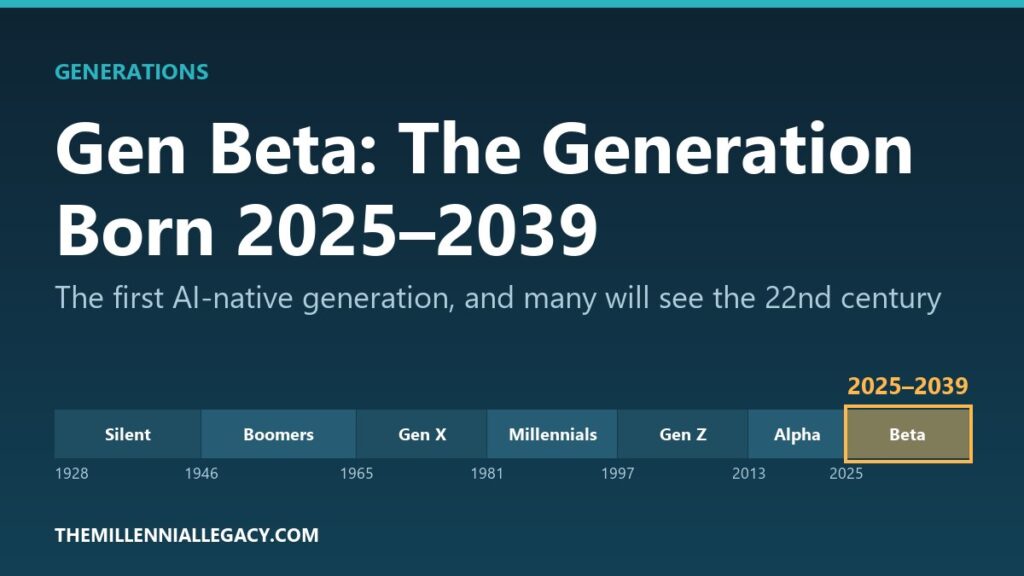
If you had a baby on or after January 1, 2025, congratulations: you’re raising a member of Generation Beta. Your kid is part of the first generation that will never know a world without AI assistants. Many of them will also live to see the 22nd century.
The label is new, but it’s already showing up everywhere, from parenting forums to marketing decks. Here’s what Gen Beta means, which years it covers, and what kind of world these kids are growing up in.
Gen Beta years: 2025 to 2039
Gen Beta is generally defined as people born from 2025 through 2039. That range comes from Australian social researcher Mark McCrindle. He also coined “Generation Alpha,” which he dates to 2010–2024.
McCrindle’s reasoning is simple. A generation is roughly 15 years, so Gen Beta starts where Gen Alpha ends.
No official body decides generational boundaries, so you’ll see some variation. A few sources end Gen Beta in 2038, and others start it earlier because they end Gen Alpha around 2021–2022. But 2025–2039 is the range most media outlets, schools and brands have adopted.
| Generation | Birth years (common definition) | Age in 2026 |
|---|---|---|
| Millennials (Gen Y) | 1981–1996 | 30–45 |
| Gen Z | 1997–2012 | 14–29 |
| Gen Alpha | 2010–2024 | 2–16 |
| Gen Beta | 2025–2039 | 0–1 |
| Gen Gamma (proposed) | 2040–2054 | not born yet |
Notice the overlap between Gen Z and Gen Alpha above. Pew Research ends Gen Z in 2012, while McCrindle starts Alpha in 2010. That’s normal; generation edges are fuzzy. We sort out the overlap years in Gen Z vs Gen Alpha. Not sure where you land? Try our generation calculator.
Why is it called “Gen Beta”?
After Gen X, Gen Y (millennials) and Gen Z, the Latin alphabet ran out. Researchers didn’t want to restart at “Gen A,” so they switched to the Greek alphabet. That produced Gen Alpha, and Beta is the second Greek letter.
If the pattern holds, kids born from 2040 will be Gen Gamma.
Some people joke that “beta” sounds like a trial version, or like internet slang for someone who isn’t an “alpha.” Gen Alpha kids are already using it that way. In reality, the name is just alphabetical order.
What generation is 2025? What about 2026?
Both are Gen Beta. Any child born from 2025 through 2039 falls into Generation Beta under the standard definition. The first Gen Betas are only toddlers right now. The youngest won’t arrive until the late 2030s.
Who are Gen Beta’s parents?
Mostly younger millennials and older Gen Z. That matters, because these parents grew up online themselves. Many of them watched Gen Alpha get handed an iPad at age two, and they have opinions about it.
A few trends are already shaping how Gen Betas are being raised:
- Smaller families, later. U.S. birth rates are near record lows, and parents are older at first birth than in past generations. We dig into why in Millennials, Gen Z and the decline in the US birth rate.
- A pushback on screen time. Many Gen Z and millennial parents are deliberately delaying smartphones and social media for their kids. More schools are adopting phone-free policies too.
- Gentle and intentional parenting styles. Parenting is moving away from the authoritarian end of the spectrum. See our breakdown of parenting styles across generations.
- Money pressure. Childcare, housing and student loans hit these parents hard, so Gen Betas are being raised in budget-conscious households.
Gen Beta vs. Gen Alpha: what’s the difference?
Gen Alpha was the first generation born entirely in the 21st century and the first raised with smartphones and tablets from birth. Gen Beta takes that one step further.
| Gen Alpha (2010–2024) | Gen Beta (2025–2039) | |
|---|---|---|
| Defining technology | Smartphones, tablets, YouTube, TikTok | Generative AI, voice assistants, AI tutors, smart everything |
| Typical parents | Millennials | Younger millennials and Gen Z |
| Big shared event | COVID-19 pandemic and remote school | Too early to say. Likely climate impacts and AI’s effect on work. |
| Screen-time culture | “iPad kid” era | More deliberate limits from parents |
| Lifespan outlook | Many will see 2100 | Many expected to live into the 22nd century |
What will Gen Beta’s world look like?
Nobody can predict a generation that’s still in diapers. But a few forces are already locked in.
1. AI will be normal, not new
Millennials remember dial-up. Gen Z remembers the first iPhone. Gen Beta won’t remember a time before AI. They’ll learn to read with AI tutors, talk to assistants before they can type, and probably consider “googling something” as old-fashioned as a phone book.
The big open questions are about trust and privacy. What happens to kids who have a data trail from birth?
2. They’ll inherit big global problems
Climate change, aging populations and housing affordability will all shape their adulthood. McCrindle expects Gen Betas to make up about 16% of the world’s population by 2035. Many of them will be paying into systems that support a much larger older population.
3. A very long runway
Many Gen Betas are expected to live into the 2100s. That changes the math on everything from education to retirement. A 60-year career is possible.
It’s also why compound growth matters so much for them. Money invested for a newborn has more time to grow than for any generation before. More on that below.
4. Hyper-personalized everything
From learning apps to healthcare, Gen Beta will expect services built around them as individuals. That’s great for convenience. It’s less great for privacy and shared experiences.
What Gen Beta parents can do now (money edition)
This is a personal finance site, so let’s get practical. A Gen Beta baby has something no adult does: decades of compounding ahead. A few moves to consider:
- Open a 529 plan for education savings. Contributions grow tax-free when used for qualified education costs.
- Claim your baby’s Trump Account. The 2025 tax law created these child investment accounts. U.S.-citizen babies born from 2025 through 2028 with a Social Security number qualify for a $1,000 government pilot deposit. You can elect it with IRS Form 4547 or at trumpaccounts.gov. Deposits began July 4, 2026. Some employers also match it. Check the IRS update on Trump Accounts for current rules.
- Get your own emergency fund and life insurance sorted first. Your kid’s biggest financial asset is a stable household. See what no one tells you about emergency funds and why I got life insurance in my 30s.
- Benchmark yourself. Check our guide to average American savings by age to see where you stand.
This section is general information, not personalized financial advice.
Gen Beta FAQ
What years are Gen Beta?
Gen Beta covers people born from 2025 through 2039, using the definition popularized by researcher Mark McCrindle.
Is 2025 Gen Alpha or Gen Beta?
Under the standard definition, babies born in 2025 are Gen Beta. Gen Alpha ends with 2024 births.
What generation comes after Gen Beta?
Following the Greek alphabet, the next generation would be Generation Gamma, born from about 2040 onward.
What generation are Gen Beta’s parents?
Most Gen Beta parents are younger millennials (born early-to-mid 1990s) and older members of Gen Z (born late 1990s to early 2000s).
How old is the oldest Gen Beta?
As of late 2026, the oldest members of Gen Beta are about one year old.