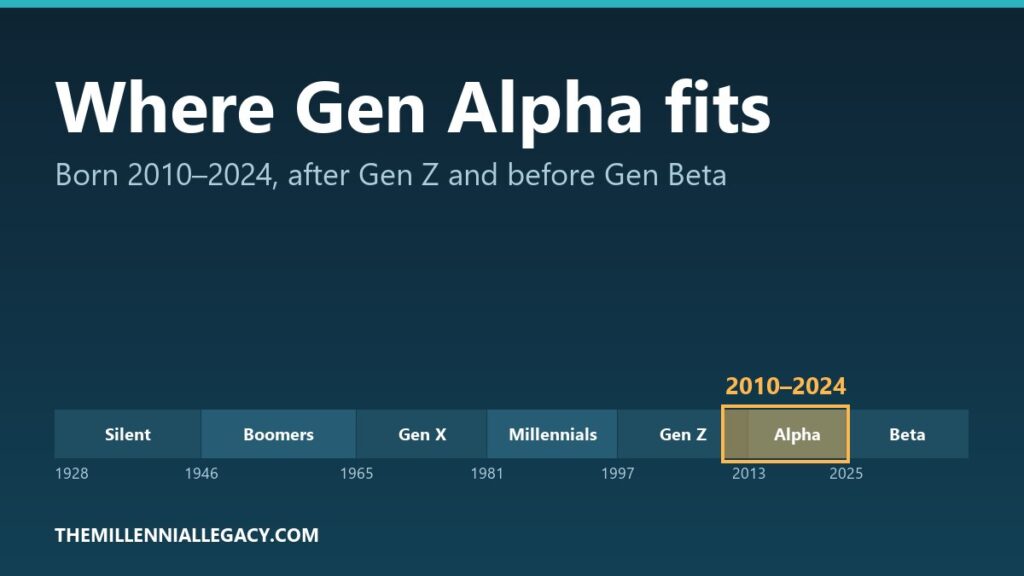
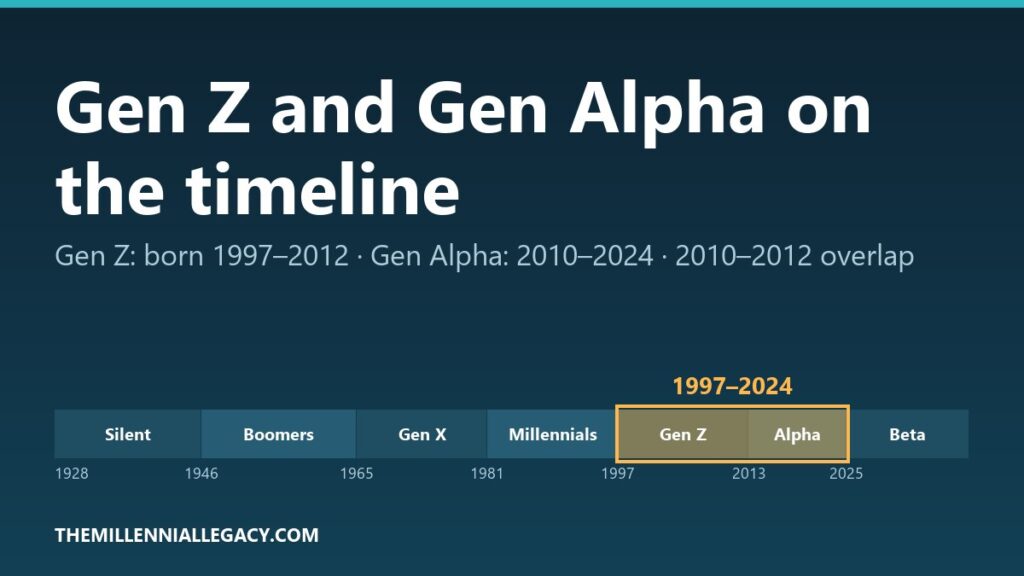
Gen Z vs Gen Alpha starts with a disputed border. Pew Research Center defines Gen Z as everyone born from 1997 to 2012, so in 2026 they turn 14 to 29. Gen Alpha, a name coined by Australian researcher Mark McCrindle, covers kids born from 2010 to 2024, who turn 2 to 16 this year. That leaves three birth years, 2010 to 2012, claimed by both.
In real life, Gen Z now fills high schools, college campuses and entry-level jobs, while Gen Alpha runs from toddlers to high schoolers. Below we sort out the overlap years, then compare the two generations at the same age, using test scores, Census counts and Pew surveys instead of personality stereotypes.
Gen Z vs Gen Alpha at a glance
| Gen Z | Gen Alpha | |
|---|---|---|
| Born | 1997–2012 (Pew) | 2010–2024 (McCrindle) |
| Age in 2026 | 14–29 | 2–16 |
| US population, mid-2024 (our estimate) | about 70.6 million | about 57.6 million, born through mid-2024 |
| Non-Hispanic white share (our estimate) | 49.9% | 47.2% |
| Typically raised by | Gen X | Millennials |
| First big screen | Smartphones, as teens | YouTube and tablets, as babies and toddlers |
| Hit by COVID-19 | The oldest were starting jobs and college | The oldest were in elementary school |
| Came before / after | Millennials / Gen Alpha | Gen Z / Gen Beta |
Method: we added up the Census Bureau’s Vintage 2024 estimates by single year of age for July 1, 2024, counting half of each edge year. Gen Alpha’s count only includes babies born by mid-2024. Want the answer for a specific birth year? Try our generation calculator.
Is 2010, 2011, 2012 or 2013 Gen Z or Gen Alpha?
The overlap comes from two different rulebooks:
- Pew Research Center set 1996 as the last millennial year and starts Gen Z in 1997, with 2012 as its last year. Pew hasn’t published dates for the generation after Gen Z. In 2023 it went further and said readers shouldn’t expect much new generational research from it at all.
- McCrindle, the Australian research firm that named Gen Alpha, uses earlier lines: Gen Z from 1995 to 2009 and Gen Alpha from 2010 to 2024. As McCrindle points out, the first Gen Alphas were born in 2010, the year the iPad launched.
Here’s how each cusp year lands:
| Born in | Turns in 2026 | Pew | McCrindle | Our call |
|---|---|---|---|---|
| 2008 | 18 | Gen Z | Gen Z | Gen Z |
| 2009 | 17 | Gen Z | Gen Z | Gen Z |
| 2010 | 16 | Gen Z | Gen Alpha | Cusp |
| 2011 | 15 | Gen Z | Gen Alpha | Cusp |
| 2012 | 14 | Gen Z | Gen Alpha | Cusp |
| 2013 | 13 | After Gen Z | Gen Alpha | Gen Alpha |
| 2014 | 12 | After Gen Z | Gen Alpha | Gen Alpha |
So is 2012 Gen Z or Gen Alpha? By Pew’s definition, Gen Z. By McCrindle’s, Gen Alpha. Kids born from 2010 to 2012 are a true cusp group, about 12.5 million Americans by our Census count. Like the zillennials between millennials and Gen Z, they can fairly claim either label. In fall 2026, most of them are high school freshmen, sophomores or juniors.
What about a 13-year-old? In 2026, a 13-year-old was born in 2012 or 2013. If 2013, they’re Gen Alpha by every definition. If 2012, it depends on whose definition you use.
Same age, different childhood: the school scorecard
Comparing a 25-year-old with a 10-year-old tells you about age, not generations. Pew makes the same point: generational comparisons only work when you look at each group at a similar stage of life. National test scores let us do that. The Nation’s Report Card (NAEP) tests fourth graders across the country.
- In 2015, the fourth graders tested were born around 2005. That’s Gen Z by every definition.
- In 2024, the fourth graders were born around 2014. That’s Gen Alpha by every definition.
| NAEP 4th grade, US | 2015 (Gen Z) | 2024 (Gen Alpha) |
|---|---|---|
| Reading, average score | 223 | 215 |
| Reading, below NAEP Basic | 31% | 40% |
| Reading, at or above Proficient | 36% | 31% |
| Math, average score | 240 | 237 |
| Math, below NAEP Basic | 18% | 24% |
| Math, at or above Proficient | 40% | 39% |
Source: NAEP national results for all schools (reading, math); 2015 figures from the NAEP data service, rounded to whole numbers.
At age 9 or 10, Gen Alpha is behind where Gen Z was, especially in reading: 4 in 10 of 2024’s fourth graders read below the Basic level, up from 3 in 10 in 2015. Most of the slide came after 2019. The 2024 fourth graders were in kindergarten when schools closed in spring 2020.
That isn’t a verdict on a generation. Pew warns about “period effects,” events that hit every age group at once, and the pandemic is a textbook case. But it does mean Gen Alpha’s early school years started from a lower baseline than Gen Z’s.
Technology: smartphone teens vs YouTube toddlers
Pew calls Gen Z digital natives with little or no memory of the world before smartphones. Gen Alpha goes a step further: screens arrived before memory did.
Gen Z at 13 to 17: – In 2014–15, when US teens were almost all Gen Z, 73% had or had access to a smartphone, and 24% said they went online “almost constantly” (Pew). – In 2025, the youngest Gen Zers by Pew’s definition (then 13 to 17) had moved on to AI: 64% used chatbots, about 3 in 10 daily, and about 1 in 5 were on TikTok or YouTube almost constantly (Pew).
Gen Alpha at 12 and under (Pew’s 2025 survey of parents): – 85% watch YouTube and 51% watch daily, up from 80% and 43% in 2020. – 62% of kids under 2 watch YouTube, up from 45% in 2020. – 23% have their own smartphone. That rises to about 6 in 10 of 11- and 12-year-olds. – 15% of 11- and 12-year-olds already use AI chatbots, and 37% use TikTok.
Put simply, Gen Z got the smartphone as teenagers. Gen Alpha met YouTube as babies and AI chatbots before middle school. For the creators both groups watch, see our breakdown of the most popular TikTok accounts by generation.
The most diverse generations yet
Pew calls Gen Z more racially and ethnically diverse than any generation before it. Our count of the latest Census estimates shows Gen Alpha going further:
| Share of each generation, mid-2024 | Millennials | Gen Z | Gen Alpha |
|---|---|---|---|
| Non-Hispanic white | 53.4% | 49.9% | 47.2% |
| Hispanic (any race) | 21.7% | 25.5% | 27.0% |
| Non-Hispanic Black | 13.7% | 13.6% | 13.9% |
| Non-Hispanic Asian | 7.9% | 6.1% | 6.0% |
| Two or more races | 2.9% | 4.9% | 6.3% |
Our calculation from Census Bureau Vintage 2024 estimates by race, Hispanic origin and single year of age. “Two or more races” includes Hispanic multiracial Americans, so columns don’t add to 100%.
Gen Z sits right at the halfway line. By our count, Gen Alpha is the first generation in which non-Hispanic white Americans are clearly a minority. The fastest-growing group is multiracial: 6.3% of Gen Alpha, more than double the millennial share.
Who’s raising them, and the money they start with
Gen Z is typically the children of Gen X, and Gen Alpha the children of millennials, McCrindle notes. That shift shows up in everything from screen-time rules to parenting styles. Millennial parents are also having fewer kids, later. We dig into that in Millennials, Gen Z and the decline in the US birth rate. For more on the parents themselves, see our guide to the millennial generation.
The money picture is different too:
- Gen Z took an early hit. In March 2020, half of Gen Zers aged 18 to 23 said they or someone in their household had lost a job or taken a pay cut because of the pandemic, more than any older generation (Pew). If you’re Gen Z and building a cushion now, start with an emergency fund, check savings by age, and weigh a Roth IRA or 401(k).
- Gen Alpha can get a Trump Account. These new tax-advantaged accounts can be opened for any child under 18 with a Social Security number, and family, employers and others can contribute from July 4, 2026. The $1,000 federal starter deposit only goes to children born from 2025 to 2028, which means Gen Beta, not Gen Alpha (IRS). Millennial parents planning for the long run may also want to read why life insurance in your 30s is worth a look.
Slang, culture and those “traits” lists
Many Gen Z vs Gen Alpha articles list personality traits: Gen Z is anxious, Gen Alpha is impatient, and so on. Take those with a grain of salt. Pew, the source of the most widely used Gen Z definition, says much of the generational content out there is “more like clickbait or marketing mythology.” A typical generation spans 15 to 18 years, and kids born in 2010 and 2024 won’t share a single personality.
Language is where the difference is easy to hear. Gen Alpha’s “6-7” was Dictionary.com’s Word of the Year for 2025. Our Gen Alpha slang guide translates the newest terms.
What comes after Gen Alpha?
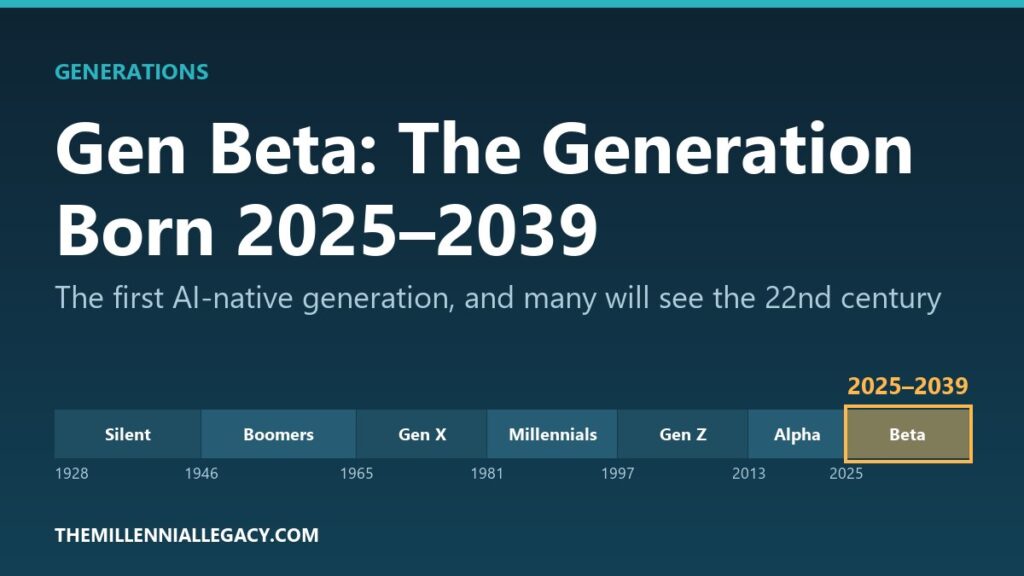
Gen Beta, the kids born from 2025 to 2039. Their parents are mostly younger millennials and the oldest Gen Zers, which means the first Gen Z parents are raising the generation after Gen Alpha.
Not sure where everyone in your family fits? Run each birth year through our generation calculator.
Gen Z vs Gen Alpha FAQ
What years are Gen Z and Gen Alpha?
Pew Research Center defines Gen Z as people born from 1997 to 2012. Gen Alpha, as defined by McCrindle, the researchers who named it, covers kids born from 2010 to 2024. The two definitions overlap for 2010, 2011 and 2012.
Is 2012 Gen Z or Gen Alpha?
Both, depending on who you ask. Pew counts 2012 as the last Gen Z year, while McCrindle counts it as Gen Alpha. Kids born from 2010 to 2012 are on the Gen Z–Gen Alpha cusp. Anyone born in 2013 or later is Gen Alpha by every common definition.
Is a 13-year-old Gen Z or Gen Alpha?
In 2026, a 13-year-old was born in 2012 or 2013. Born in 2013, they’re Gen Alpha by every definition. Born in 2012, they’re Gen Z by Pew’s definition and Gen Alpha by McCrindle’s.
How old is Gen Alpha in 2026?
Gen Alpha turns 2 to 16 in 2026, if you use McCrindle’s 2010–2024 birth years. The oldest are in high school, and the youngest are toddlers.
What is the biggest difference between Gen Z and Gen Alpha?
Timing and technology. Gen Z got smartphones as teenagers. Gen Alpha grew up with YouTube and tablets from babyhood, was in early grades when COVID closed schools, and is mostly being raised by millennials rather than Gen X.
What generation comes after Gen Alpha?
Gen Beta, the kids born from 2025 to 2039. Most of their parents are younger millennials and older Gen Zers.
Sources
- McCrindle – Generation Alpha defined
- McCrindle – Gen Z and Gen Alpha infographic update
- Pew Research Center – Defining generations, where Millennials end and Generation Z begins (2019)
- Pew Research Center – What we know about Gen Z so far (2020)
- Pew Research Center – How Pew Research Center will report on generations moving forward (2023)
- Pew Research Center – Teens, social media and technology overview 2015
- Pew Research Center – Teens, social media and AI chatbots 2025
- Pew Research Center – How parents describe their kids’ tech use (2025)
- The Nation’s Report Card – NAEP 2024 reading, grade 4 national trends
- The Nation’s Report Card – NAEP 2024 mathematics, grade 4 national trends
- U.S. Census Bureau – National population by characteristics, 2020–2024 (race and Hispanic origin by single year of age)
- IRS – Trump Accounts enrollment update
- Dictionary.com – Word of the Year 2025 (67)