
The millennial generation, also called Generation Y or Gen Y, is made up of Americans born from 1981 to 1996, according to Pew Research Center. Millennials turn 30 to 45 in 2026. With about 74.2 million people in mid-2024, by our estimate from Census Bureau data, they’re the largest generation in the United States, a little more than 1 in 5 Americans.
2026 is a turning point: the youngest millennials turn 30 this year. The generation that spent two decades as shorthand for “young people” is now entirely in its 30s and 40s, buying first homes at record-late ages and raising the next generation. Here’s who counts as a millennial, how old they are, what shaped them and where they stand with money.
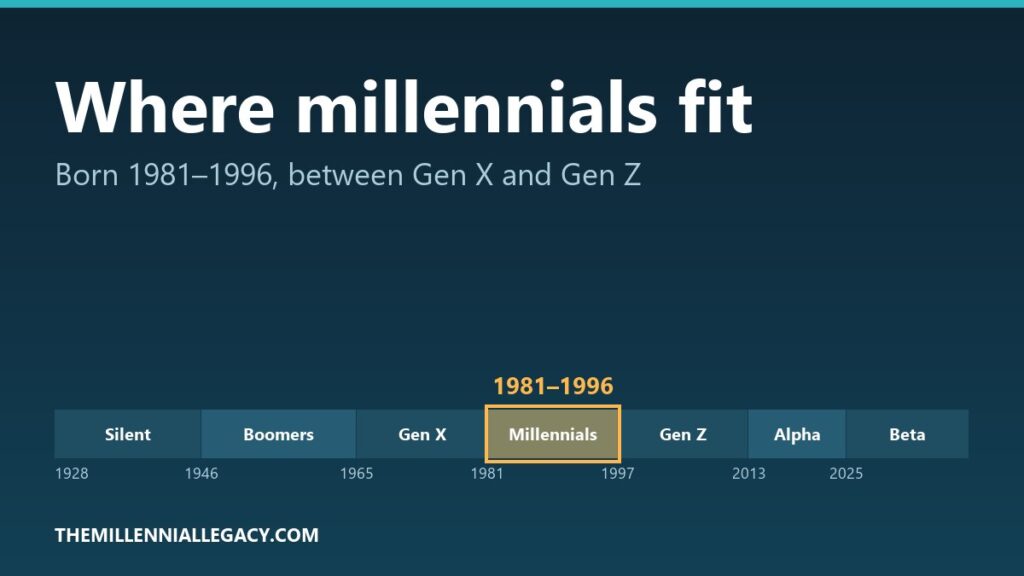
Millennial years: which birth years count?
There’s no official definition. The Census Bureau officially designates only the baby boomers. So the millennial years depend on who you ask:
| Source | Millennial (Gen Y) birth years | Notes |
|---|---|---|
| Pew Research Center | 1981–1996 | The most-cited US definition, set in 2018 |
| U.S. Census Bureau (2015 release) | 1982–2000 | Used to report that millennials had outnumbered boomers |
| McCrindle Research (Australia) | 1980–1994 | Gen Y, based on Australian birth-rate data |
| Early “Gen Y” usage (TIME) | 1980–2000 | Before “millennials” caught on |
| Redfin housing research | 1981–1996 | Matches Pew |
The core everyone agrees on: 1982 to 1994. If you were born in those years, every definition above calls you a millennial. The edges are where it gets murky. Some people born around 1980 to 1981 feel more like Gen X. People born from about 1993 to 1998 often relate to both millennials and Gen Z, and many call themselves zillennials.
How old are millennials in 2026?
| Born | Turns in 2026 | Born | Turns in 2026 |
|---|---|---|---|
| 1981 | 45 | 1989 | 37 |
| 1982 | 44 | 1990 | 36 |
| 1983 | 43 | 1991 | 35 |
| 1984 | 42 | 1992 | 34 |
| 1985 | 41 | 1993 | 33 |
| 1986 | 40 | 1994 | 32 |
| 1987 | 39 | 1995 | 31 |
| 1988 | 38 | 1996 | 30 |
So the millennial age range in 2026 is 30 to 45. Ages are as of your birthday this year. Not sure where you land? Look up your birth year in our generation calculator.
How big is the millennial generation?
By our estimate, about 74.2 million Americans were millennials on July 1, 2024. That’s 21.8% of the population and more than any other generation:
| Generation (Pew years) | Population, mid-2024 | Share of US |
|---|---|---|
| Millennials (1981–1996) | about 74.2 million | 21.8% |
| Gen Z (1997–2012) | about 70.6 million | 20.8% |
| Baby boomers (1946–1964) | about 68.0 million | 20.0% |
| Gen X (1965–1980) | about 65.7 million | 19.3% |
Method: we summed the Census Bureau’s Vintage 2024 single-year-of-age estimates, counting half of each edge year.
Millennials first passed the boomers in 2019, according to Pew. Young immigrants keep adding to the millennial ranks, while the boomer population shrinks with age. By mid-2024, millennials outnumbered boomers by about 6 million.
Where the name “millennials” came from
The writers William Strauss and Neil Howe used the term “millennials” in their 1991 book Generations, and the name stuck, TIME recounts. Merriam-Webster also dates the noun to 1991. The name points to the new millennium, which arrived as the oldest millennials were reaching adulthood.
Generation Y followed the alphabetical pattern set by Gen X and was used for people born from about 1980 to 2000. The two names are interchangeable today, though “millennials” won out in everyday use.
Funny enough, many millennials never liked the label. In a 2015 Pew survey, only 40% of adults ages 18 to 34 considered themselves part of the “Millennial generation,” and 33%, mostly older millennials, identified with Gen X instead. Millennials were also their own harshest critics: 59% said “self-absorbed” described their generation, 49% said “wasteful” and 43% said “greedy,” far more than older generations said of themselves.
What shaped the millennial generation
Pew drew the line at 1996 because of the events millennials lived through:
- 9/11 and two wars. Most millennials were 5 to 20 on September 11, 2001, and many were old enough to grasp what it meant. They grew up in the shadow of the wars in Iraq and Afghanistan.
- The 2008 election. Most millennials were 12 to 27 during the 2008 election, when the youth vote became part of the story and helped elect the first Black president.
- The Great Recession. Most millennials came of age and entered the workforce at the height of the recession. Pew notes that this “slow start” shaped their earnings, life choices and the timing of adulthood in ways that will matter for decades.
- The internet explosion. Boomers grew up with TV and Gen X with the personal computer. Millennials came of age as the internet took off and adapted to social media as it arrived. For Gen Z, those tools were there from the start.
What are millennials known for?
Technology. Millennials came of age during the internet explosion. They have a reputation as technologically savvy early adopters, especially of social media. See how their habits have changed in our look at millennial social media trends.
Diversity. Pew calls millennials the most racially and ethnically diverse adult generation in US history. When the Census Bureau counted millennials (born 1982–2000) in 2014, 44.2% were part of a racial or ethnic minority group. Gen Z is more diverse still.
Changing social views. Millennials were at the leading edge of shifting opinion on same-sex marriage. In 2014, 52% of all adults favored allowing gay and lesbian couples to marry, compared with 67% of millennials, Pew found. Read more about how the generations split on politics.
New ways to work. Millennials started their careers in a weak job market, and many built work lives that look different from their parents’ 9-to-5. Read about the gig economy and how millennials approach teamwork. Some have built enormous fortunes: see the richest millennials in the world and where they rank on the Bloomberg Billionaires Index.
We also track how millennials approach wellness, healthcare, the environment and family life.
Millennials and money in 2026
Millennials started late, then caught up fast. Here’s where they stand, using the Federal Reserve’s Distributional Financial Accounts (our calculations). One caveat: the Fed’s “millennial” group covers everyone born in 1981 or later, so it also includes adult Gen Z households.
| Fed’s millennial group (born 1981 or later) | Total net worth | Share of all US household wealth |
|---|---|---|
| End of 2019 | $4.3 trillion | 4.0% |
| End of 2021 | $10.9 trillion | 7.7% |
| End of 2023 | $13.5 trillion | 9.2% |
| Mid-2026 (Q2) | $20.8 trillion | 11.2% |
- They passed an older generation. In the second quarter of 2026, the millennial group’s $20.8 trillion topped the $19.8 trillion held by the Silent Generation and older Americans for the first time.
- Ahead of where Gen X was. Households headed by someone 45 or younger held 11.2% of US household wealth in mid-2026. In mid-2010, when that age group was mostly Gen X, it held 9.2%. That comparison flatters today’s young adults a little, because 2010 came right after the housing and stock crash.
- Heavy on debt. The millennial group owes about 43% of all US home-mortgage debt and 46% of consumer credit, more than any other generation group.
- Homeownership lags. 55.4% of millennial-led households owned their home in 2025. At age 36, 57.2% own, compared with 61.2% of Gen X and 63.7% of boomers at that age (Redfin).
- First homes come late. The typical first-time buyer is now 40, a record, according to the National Association of Realtors. That’s a millennial born in the mid-1980s.
Your money in your 30s and 40s: see how you compare on savings by age and retirement savings by age, choose between a Roth IRA and a 401(k), set an S&P 500 strategy for your age, and read why life insurance in your 30s is worth a look.
Millennials as parents
Many millennials are now raising the next generations. Most of their kids are Gen Alpha, and babies born since 2025 belong to Gen Beta. Read how millennials and Gen Z fit into the decline in the US birth rate. And if your kids keep shouting “6-7,” our Gen Alpha slang guide explains what they mean. For a laugh in the other direction, here’s a refresher on millennial slang.
Millennials and their neighbors
| Generation | Born | Age in 2026 |
|---|---|---|
| Gen X | 1965–1980 | 46–61 |
| Millennials (Gen Y) | 1981–1996 | 30–45 |
| Zillennials (cusp) | about 1993–1998 | about 28–33 |
| Gen Z | 1997–2012 | 14–29 |
| Gen Alpha | early 2010s–2024 | children |
| Gen Beta | 2025– | babies |
Want the years for every generation? Use our generation calculator. To see how millennials stack up against the generation right behind them at the same age, read millennials vs Gen Z. If you have an older millennial in the family, they may recognize themselves in the geriatric millennial label too.
Everyone seems to have an opinion about millennials. Now you have the numbers.
Millennial Generation FAQ
What years are millennials?
Pew Research Center defines millennials as Americans born from 1981 to 1996. Other sources stretch the range from 1980 to as late as 2000. Anyone born from 1982 to 1994 counts as a millennial under every common definition.
How old are millennials in 2026?
Millennials turn 30 to 45 in 2026. The oldest, born in 1981, turn 45, and the youngest, born in 1996, turn 30.
Is Gen Y the same as millennials?
Yes. Generation Y, or Gen Y, is another name for the same group, following the alphabetical pattern set by Gen X. “Millennials” became the more popular name, and Pew uses it.
Is someone born in 1996 or 1997 a millennial?
By Pew’s definition, 1996 is the last millennial birth year and 1997 is the first year of Gen Z. People born from about 1993 to 1998 often relate to both and are sometimes called zillennials.
Why are they called millennials?
Generational writers William Strauss and Neil Howe used the term in their 1991 book Generations. The name points to the new millennium, which arrived as the oldest members were reaching adulthood.
How many millennials are there?
About 74.2 million in the US in mid-2024, by our estimate from Census Bureau data. That’s roughly 1 in 5 Americans and makes millennials the country’s largest generation.
Sources
- Pew Research Center – Defining generations, where Millennials end and Generation Z begins (2019)
- U.S. Census Bureau – Millennials outnumber baby boomers and are far more diverse (June 25, 2015)
- Australian Law Reform Commission – Generational differences in attitudes to privacy (McCrindle’s Gen Y range)
- TIME – How every generation of the last century got its nickname
- Merriam-Webster – millennial (noun, first known use 1991)
- Pew Research Center – Most Millennials resist the ‘Millennial’ label (2015)
- Pew Research Center – Generation Z looks a lot like Millennials on key social and political issues (2019)
- Pew Research Center – Millennials overtake Baby Boomers as America’s largest generation (2020)
- U.S. Census Bureau – National population by characteristics, 2020–2024 (single year of age)
- Federal Reserve – Distributional Financial Accounts, wealth by generation (data through 2026:Q2)
- Redfin – Homeownership rate by generation, 2025
- NAR – First-time home buyer share falls to historic low of 21%, median age rises to 40 (Nov. 4, 2025)