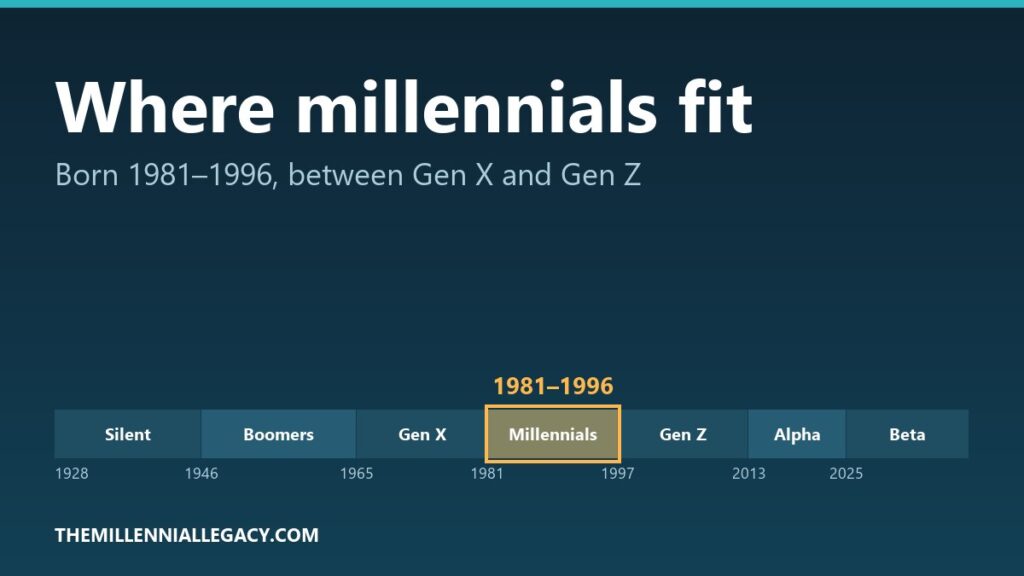
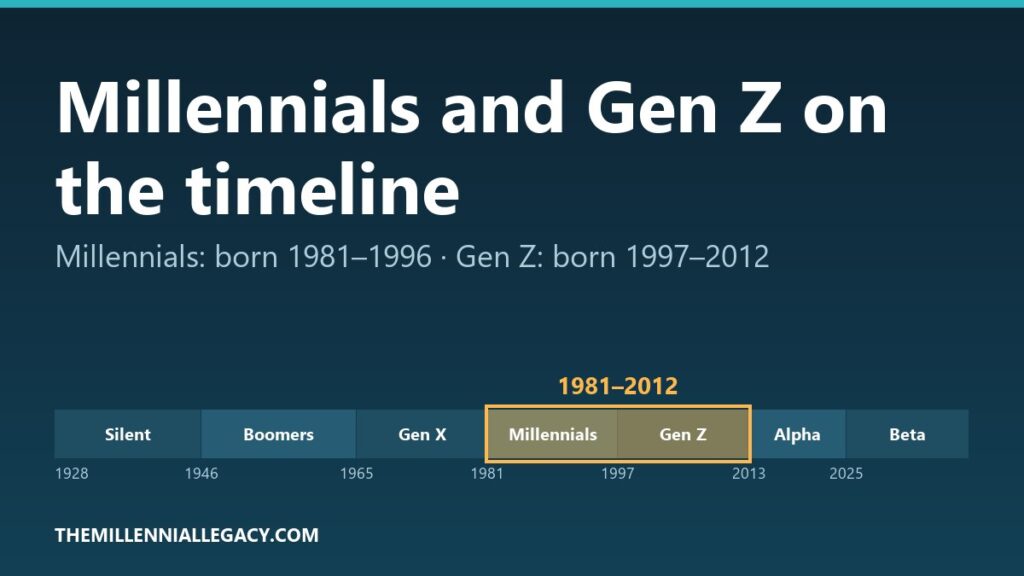
Millennials vs Gen Z comes down to timing. Millennials were born from 1981 to 1996 and turn 30 to 45 in 2026. Gen Z was born from 1997 to 2012 and turns 14 to 29, according to Pew Research Center’s definitions. That makes 2026 a milestone: the youngest millennials turn 30 this year, so by December, for the first time, every American in their 20s is Gen Z.
The memes say millennials love avocado toast and Gen Z can’t make a phone call. The data tells a more useful story. When you compare the two generations at the same age, Gen Z is more likely to be in college and slightly more likely to own a home by 28, but less likely to have a job in their late teens. Here’s how they really compare.
Millennials vs Gen Z at a glance
| Millennials (Gen Y) | Gen Z | |
|---|---|---|
| Born (Pew) | 1981–1996 | 1997–2012 |
| Age in 2026 | 30–45 | 14–29 |
| US population, mid-2024 (our estimate) | about 74.2 million (21.8%) | about 70.6 million (20.8%) |
| Came before / after | Gen X / Gen Z | Millennials / Gen Alpha |
| Came of age with | The internet explosion | Smartphones and social media from the start |
| Defining shock | The Great Recession, as most entered the workforce | COVID-19: the oldest were 23 in 2020 |
| Life stage in 2026 | Mid-career | High school, college and first jobs |
Method: we summed the Census Bureau’s Vintage 2024 single-year-of-age estimates for July 1, 2024, counting half of each edge year. Gen Z’s count includes children as young as 11. Not sure which side you’re on? Try our generation calculator.
Same age, different starting line
Most comparisons put a 25-year-old Gen Zer next to a 40-year-old millennial and call the gap “generational.” That’s mostly just age. A fairer test is to compare each generation at the same age. Pew Research Center did exactly that with Census Bureau data, setting Gen Z in 2017–2018 against millennials at the same ages in 2002. Redfin did the same for homeownership.
| Same-age measure | Gen Z | Millennials | Edge |
|---|---|---|---|
| In college (ages 18–20, out of high school) | 59% | 53% | Gen Z |
| Has a parent with a bachelor’s degree (ages 6–17) | 43% | 32% | Gen Z |
| Dropped out of high school (ages 18–20) | 6% | 12% | Gen Z |
| Typical household income growing up (inflation-adjusted) | $63,700 | $62,400 | About even |
| Worked at some point in the past year (ages 18–21) | 58% | 72% | Millennials |
| Married (ages 18–21) | 4% | 7% | Gen Z waits longer |
| Moved in the past year (ages 6–21) | 11% | 17% | Gen Z moves less |
| Owns a home at age 28 | 38.3% | 36.8% | Gen Z, narrowly |
Sources: Pew Research Center (Gen Z 2017–2018 vs millennials 2002); Redfin (homeownership, 2025).
Three things stand out:
- Gen Z is on track to be the best-educated generation. Pew found a higher college enrollment rate and half the dropout rate millennials had at the same age. Their parents are better educated too.
- Gen Z works later. Only 58% of 18- to 21-year-olds had worked in the previous year, versus 72% of millennials at that age. Pew links this largely to more of them being in college.
- Homeownership is a near tie, and both trail their parents. At 28, 38.3% of Gen Zers owned their home in 2025, a little ahead of millennials’ 36.8% at that age. Both are behind Gen X (42.5%) and baby boomers (44.4%) at 28.
The events that split them
Pew drew the line at 1996 because of what each group lived through, not because of any single trait.
| Moment | Millennials | Gen Z |
|---|---|---|
| 9/11 (2001) | Most were 5 to 20, many old enough to grasp what it meant | Most have little or no memory of it |
| 2008 election | Most were 12 to 27, and the youth vote became a story | 11 or younger |
| iPhone launch (2007) | Most were teens or young adults | The oldest were 10 |
| Great Recession (2007–09) | Most came of age and started work as it hit | Children |
Source: Pew Research Center.
That recession left a mark. Pew notes that the “slow start” shaped millennials’ life choices, future earnings and entry into adulthood in ways that may not apply to Gen Z, and expects the effects to last for decades.
Technology: adapters vs natives
Millennials came of age during the internet explosion. Social media, constant connectivity and on-demand entertainment arrived while they were growing up, and they adapted. For Gen Z, Pew notes, those things have been part of life from the start: by their teens, most young Americans were going online mainly through phones, Wi-Fi and fast cellular service.
Today’s teenagers, the youngest of Gen Z, show where that leads. In Pew’s 2025 survey:
- About 1 in 5 teens say they’re on TikTok and YouTube “almost constantly.”
- 64% use AI chatbots, and about 3 in 10 do so daily.
- Only 31% use Facebook, down from 71% in 2014–15. X (formerly Twitter) is down to 16%.
Gen Z lives on video apps and is first in line for AI tools. See how that plays out on TikTok’s most popular accounts. The slang changes too: compare millennial slang with what Gen Alpha says now.
Views: more alike than the memes suggest
Online, millennials and Gen Z trade insults about skinny jeans and side parts. On the big questions they mostly agree. When Pew surveyed both in 2018, Gen Z’s views looked a lot like millennials’ and differed more from older generations.
| Pew survey, 2018 | Gen Z | Millennials |
|---|---|---|
| Same-sex marriage has been good for the country | 48% | 47% |
| Black people are treated less fairly than white people | 66% | 62% |
| The US is better than all other countries | 14% | 13% |
| Know someone who prefers gender-neutral pronouns | 35% | 25% |
| Forms should offer gender options besides “man” or “woman” | 59% | 50% |
Source: Pew Research Center. Gen Z was 13 to 21 at the time.
The clearest gap is on gender identity, where Gen Z is more likely to know someone who uses gender-neutral pronouns. On race, marriage and America’s place in the world, the two generations are within a few points of each other.
Work and money
The money gap between the two is mostly an age gap, but both generations face the same obstacle: housing.
- Homeownership: 55.4% of millennial-led households owned their home in 2025, compared with 27.1% for Gen Z, according to Redfin. The bigger worry is the trend. At 36, 57.2% of millennials own, below Gen X (61.2%) and boomers (63.7%) at that age.
- First-time buyers are older than ever. The typical first-time buyer is now 40, a record, and first-timers made up just 21% of buyers, also a record low (NAR, 2025). A 40-year-old today is a millennial.
- Wealth: the Federal Reserve doesn’t track Gen Z separately yet. Its “millennial” group covers everyone born in 1981 or later, adult Gen Z included. That group held about $20.8 trillion, or 11.2% of US household wealth, in mid-2026, up from 4.0% at the end of 2019, by our calculation from the Fed’s Distributional Financial Accounts. In that quarter it passed the Silent Generation and older Americans for the first time.
- Work: Gen Z starts working later, mostly because more of them are in school. For how side gigs fit into both generations’ careers, see our look at the gig economy.
What it means for your money at each stage:
- Gen Z (14–29): build the basics first: an emergency fund, renters insurance, and a healthy skepticism of money advice on TikTok.
- Millennials (30–45): this is the catch-up decade. Check yourself against savings by age and retirement savings by age, and decide between a Roth IRA and a 401(k).
Born on the line? Zillennials and cusp years
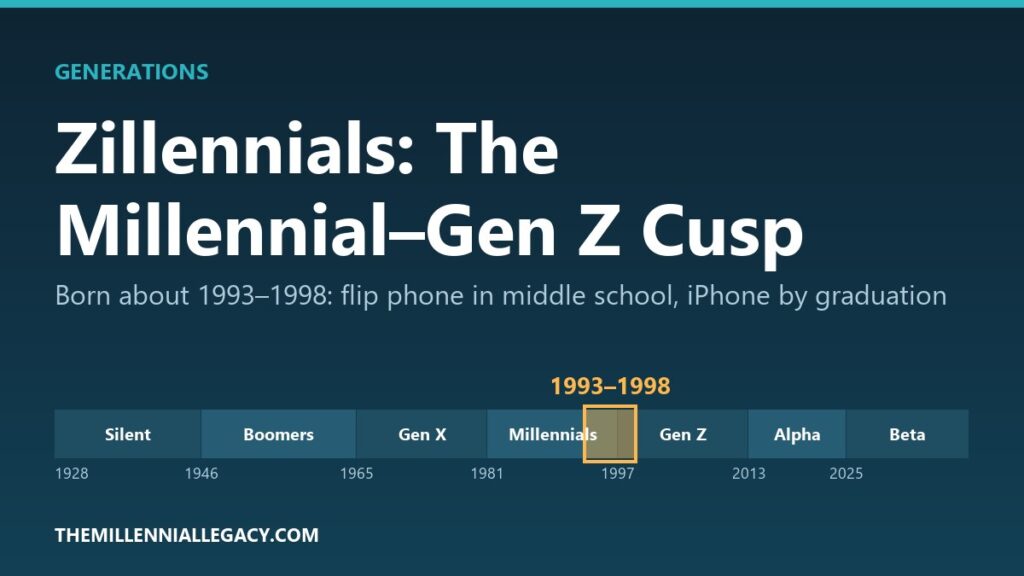
Generations don’t flip overnight on January 1, 1997. Even Pew says generational cutoff points “aren’t an exact science.” People born from roughly 1993 to 1998 often say they don’t fit either label, and many call themselves zillennials.
The same blur happens at the other end. Many of the oldest millennials, born around 1981, relate more to Gen X. Today’s kids, Gen Alpha and the babies of Gen Beta, are mostly being raised by millennials and older Gen Zers. For the full picture of the older group, read our guide to the millennial generation.
Millennials vs Gen Z FAQ
What years are millennials and Gen Z?
Pew Research Center defines millennials as people born from 1981 to 1996 and Gen Z as people born from 1997 to 2012. Other researchers shift the line by a year or two, but Pew’s 1996/1997 cutoff is the one most often cited.
How old are millennials and Gen Z in 2026?
Millennials turn 30 to 45 in 2026, and Gen Z turns 14 to 29. By the end of 2026, for the first time, no millennial is in their 20s.
Am I a millennial or Gen Z if I was born in 1996 or 1997?
By Pew’s definition, 1996 is the last millennial year and 1997 is the first Gen Z year. People born from about 1993 to 1998 often feel like neither, and many call themselves zillennials.
What is the biggest difference between millennials and Gen Z?
Timing. Millennials adapted to smartphones and social media as teens or adults, and many started work during the Great Recession. Gen Z never knew life without them. At the same age, Gen Z is more likely to be in college and less likely to have a job.
Which generation is bigger, millennials or Gen Z?
Millennials, for now. By our estimate from Census Bureau data, there were about 74.2 million millennials and 70.6 million Gen Zers in the US in mid-2024. Both groups grew from 2020 to 2024 as young immigrants arrived.
Is Gen Y the same as millennials?
Yes. Gen Y and millennials are two names for the same generation, the one that came after Gen X and before Gen Z.
Sources
- Pew Research Center – Defining generations, where Millennials end and Generation Z begins (2019)
- Pew Research Center – Early benchmarks show post-Millennials on track to be most diverse, best-educated generation yet (2018)
- Pew Research Center – Generation Z looks a lot like Millennials on key social and political issues (2019)
- Pew Research Center – Teens, social media and AI chatbots 2025
- Redfin – Homeownership rate by generation, 2025
- NAR – First-time home buyer share falls to historic low of 21%, median age rises to 40 (Nov. 4, 2025)
- Federal Reserve – Distributional Financial Accounts, wealth by generation (data through 2026:Q2)
- U.S. Census Bureau – National population by characteristics, 2020–2024 (single year of age)