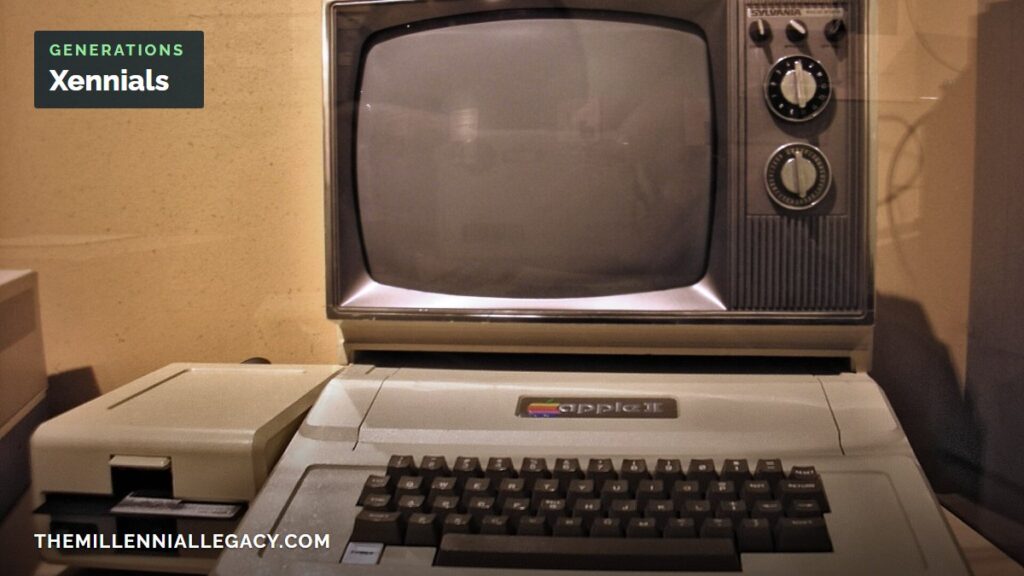
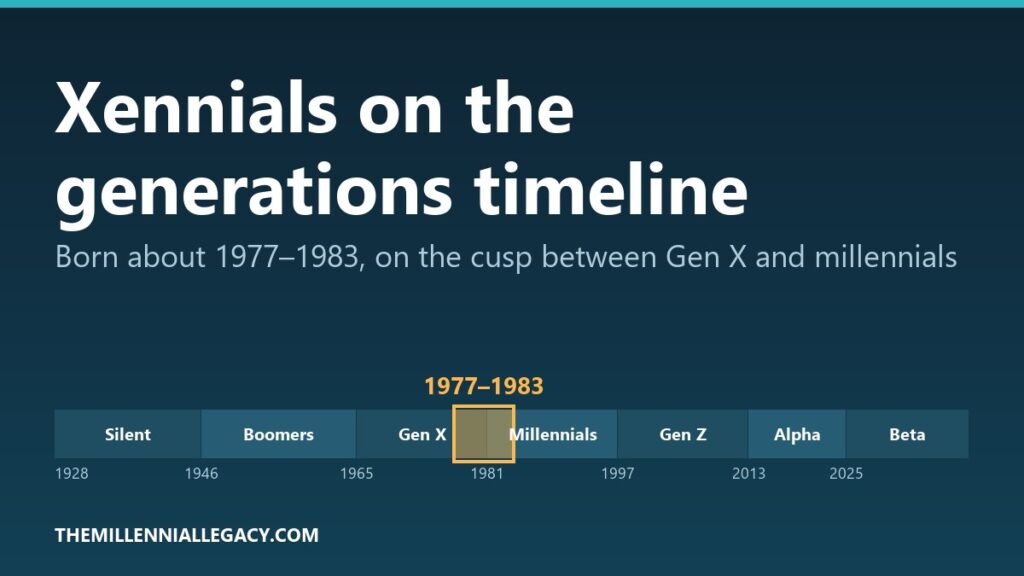
Xennials are the people born on the cusp between Gen X and millennials, usually defined as 1977 to 1983. In 2026 they turn 43 to 49. By our count of Census Bureau estimates, about 30 million Americans were born in those years, roughly 9% of the population.
What sets Xennials apart is timing. They had an analog childhood of landlines, mixtapes and paper maps, then met the internet as teenagers or young adults, early enough to learn it without help. Below, we compare every definition of the Xennial years, show where each birth year lands, and look at what being in your 40s means for Xennial money right now.
What is a Xennial?
A Xennial is someone born at the boundary between Generation X and the millennials who doesn’t feel fully like either. The word blends “Gen X” and “millennial.”
Writer Sarah Stankorb coined it in a 2014 GOOD magazine article written with Jed Oelbaum, according to Merriam-Webster. Stankorb, born in 1980, described a group old enough to have opened its first email accounts in college, who use social media but remember life before it.
How do you say it? Stankorb pronounces the X like the one in “xylophone,” so it sounds like “ZEN-ee-ul,” Merriam-Webster notes. You’ll also hear “EX-en-ee-ul.”
Xennials have gone by other names too:
- Generation Catalano, from Jordan Catalano, Jared Leto’s character on My So-Called Life. Doree Shafrir used it in a 2011 Slate article.
- The Oregon Trail Generation, after the computer game many of them played in school. Writer Anna Garvey used it in 2015.
Xennial years: every definition compared
There’s no official definition, so the years depend on who you ask. The range you’ll see most often is 1977 to 1983. Merriam-Webster says some consider Xennials to be those born in those years. Even the coiners didn’t use it, though: their GOOD article defined Xennials as born 1979 to 1983.
| Source | Name used | Born | Age in 2026 |
|---|---|---|---|
| Doree Shafrir, Slate (2011) | Generation Catalano | 1977–1981 | 45–49 |
| Stankorb and Oelbaum, GOOD (2014) | Xennials | 1979–1983 | 43–47 |
| J.D. Power, cited by Merriam-Webster (2017) | Xennials | 1978–1983 | 43–48 |
| Merriam-Webster (2017) | Xennials | 1977–1983 | 43–49 |
| Dan Woodman, The Conversation (2017) | Xennials | late 1970s to early 1980s | about 43–49 |
| Our range | Xennials | 1977–1983 | 43–49 |
We use 1977–1983 because it’s the most widely used range and it covers the core years of every definition above. Ages are the age each group turns during 2026.
Is 1980, 1981 or 1983 Gen X, millennial or Xennial?
The Xennial years straddle the line drawn by the big generation definitions, and those definitions don’t agree with each other either. Pew Research Center ends Gen X in 1980. The Australian research firm McCrindle starts Gen Y in 1980. William Strauss and Neil Howe, who named the millennials in their 1991 book Generations, keep Gen X going through 1981.
| Born in | Turns in 2026 | Pew | McCrindle | Strauss & Howe | Xennial? |
|---|---|---|---|---|---|
| 1977 | 49 | Gen X | Gen X | Gen X | Yes |
| 1978 | 48 | Gen X | Gen X | Gen X | Yes |
| 1979 | 47 | Gen X | Gen X | Gen X | Yes |
| 1980 | 46 | Gen X | Gen Y | Gen X | Yes |
| 1981 | 45 | Millennial | Gen Y | Gen X | Yes |
| 1982 | 44 | Millennial | Gen Y | Millennial | Yes |
| 1983 | 43 | Millennial | Gen Y | Millennial | Yes |
| 1984 | 42 | Millennial | Gen Y | Millennial | Only in wider ranges |
| 1985 | 41 | Millennial | Gen Y | Millennial | Only in wider ranges |
So is 1983 Xennial or millennial? Both. Every major definition calls 1983 a millennial year, and it’s also the last year of the usual Xennial range. The real toss-ups are 1980 and 1981, which get a different label depending on whose chart you read. Want the answer for your exact year? Try our generation calculator, which shows every definition side by side.
How many Xennials are there?
About 29.9 million people living in the U.S. were born from 1977 to 1983, by our estimate from the Census Bureau’s Vintage 2025 population estimates. That’s roughly 9% of the country’s 341.8 million people.
Each Xennial birth year has between 4.0 million and 4.4 million people today, growing slightly from 1977 to 1983. On Pew’s chart, about 16.7 million of them (born 1977–1980) count as Gen X, and about 13.2 million (born 1981–1983) as millennials. For comparison, the same method gives about 64.5 million for all of Gen X and 73.1 million for all millennials.
Method: we added up the Census Bureau’s July 1, 2025 estimates by single year of age. Because each birth year spans two ages on July 1, we counted half of each age at the edges. These are people living in the U.S. now, including immigrants, not the number of babies born in those years.
How old were Xennials when…
This is what “analog childhood, digital adulthood” looks like in numbers. Ages are the age each group turned that year.
| Year | What happened | Oldest Xennials (born 1977) | Youngest Xennials (born 1983) |
|---|---|---|---|
| 1986 | The space shuttle Challenger broke apart after launch | 9 | 3 |
| 2000 | 52% of U.S. adults used the internet, per Pew | 23 | 17 |
| 2002 | 62% of U.S. adults owned a cellphone, per Pew | 25 | 19 |
| 2004 | Facebook launched for college students | 27 | 21 |
| 2007 | The first iPhone went on sale, and the Great Recession began in December | 30 | 24 |
| 2011 | 35% of U.S. adults owned a smartphone, per Pew | 34 | 28 |
| 2020 | The COVID-19 pandemic began | 43 | 37 |
The pattern is clear. Every Xennial was a child or a teenager before most American adults were online, and every one of them was an adult before smartphones caught on.
Am I a Xennial? 12 signs
- You played The Oregon Trail in a school computer lab, and someone in your party died of dysentery.
- You made mixtapes by waiting for a song on the radio with your finger on Record.
- You rewound VHS rentals before returning them, to avoid the fee.
- Your family’s phone was attached to the kitchen wall, and the cord stretched into the hallway for privacy.
- You looked up numbers in the phone book and school research in a printed encyclopedia.
- Road trips ran on a paper map, plus an argument about who was reading it wrong.
- You circled the week’s shows in the TV Guide.
- You took disposable cameras on school trips and waited days to see the photos.
- You opened your first email account in high school or college.
- You had AIM away messages, and maybe a Friendster or MySpace page, before Facebook.
- Your first cellphone arrived around college or your first job. Your first smartphone came closer to 30.
- You remember life before the internet, but you were young enough to learn it without help.
If you nodded at the last few but not the first few, you may be a core millennial. Our millennial slang guide and the Millennial Generation guide will help you decide.
Xennials vs Gen X vs millennials
| Core Gen X (~1965–1976) | Xennials (~1977–1983) | Core millennials (~1984–1996) | |
|---|---|---|---|
| Age in 2026 | 50–61 | 43–49 | 30–42 |
| Got online | As adults | As older teens or young adults | As kids or teens |
| First cellphone | Adulthood | College or first job | Middle or high school |
| Joined social media | Well into adulthood | Late teens to 20s | In school or college |
| Economy at career start | Early-1990s recession, then the ’90s boom | The 2001 recession for the oldest, the mid-2000s boom for the rest | The Great Recession or its aftermath |
| Where many are now | Kids grown or nearly grown, retirement in view | Kids at home and aging parents | Young kids, first homes |
For the two big groups on either side, see our guide to Millennials vs Gen Z. The other cusp groups are Generation Jones, between Boomers and Gen X, and zillennials, between millennials and Gen Z.
Xennials and money at 43 to 49
Xennials are now in what are usually peak earning years, often with children at home and parents who need more help. Here’s what the data says about that stage of life.
- Net worth. In the Federal Reserve’s 2025 Survey of Consumer Finances, families headed by someone aged 35 to 44 had a median net worth of $155,600. For ages 45 to 54 it was $253,700. Xennials were 42 to 48 at the time, so they fall across both groups. Median family incomes were $97,000 and $108,900.
- The sandwich years. Pew Research Center found that 54% of Americans in their 40s have a parent aged 65 or older and are also raising a child or helping an adult child financially. That’s more than any other age group. An emergency fund and life insurance matter most when two generations depend on you.
- The catch-up clock starts soon. At 50, savers can put extra money into retirement accounts. For 2026, the IRS allows $24,500 in a 401(k) plus an $8,000 catch-up, and $7,500 in an IRA plus a $1,100 catch-up. At 60 to 63, the 401(k) catch-up rises to $11,250.
Here’s when each of those milestones arrives for the oldest and youngest Xennials:
| Milestone | Rule | Born 1977 | Born 1983 |
|---|---|---|---|
| 401(k) and IRA catch-up contributions | From the year you turn 50 | 2027 | 2033 |
| Larger 401(k) catch-up | The years you turn 60 to 63 | 2037–2040 | 2043–2046 |
| Full Social Security retirement age | 67 for anyone born in 1960 or later (SSA) | 2044 | 2050 |
Not sure whether you’re on track? Compare yourself with average retirement savings by age, and see how an S&P 500 strategy changes at 25, 45 and 65. If you’re weighing where extra savings should go, our guide to Roth IRAs and 401(k)s walks through it.
General information only, not personalized financial advice. Contribution limits change each year, so check the IRS figures for the year you contribute.
Is “Xennial” a real generation?
Not officially. Pew Research Center doesn’t use the term and splits the Xennial years between Gen X and millennials.
Australian sociologist Dan Woodman is often credited with inventing the word. He didn’t: in The Conversation, he pointed to the 2014 GOOD article and said he’d helped spread the term by accident in 2017, after a journalist asked him about it. He’s also skeptical of it, writing that “there isn’t yet any strong academic evidence for the grouping.” He warned that generational labels tend to flatten real differences in income and background within any age group.
That’s a fair caution. A 1977 baby and a 1983 baby can have very different lives. Still, the shared timing is real: these birth years are the ones that grew up offline and came of age online. “Cusp” or “micro-generation” describes them better than “generation.”
Famous Xennials
A few well-known people born in the Xennial window:
- Tom Brady (1977)
- Kanye West (1977)
- Kim Kardashian (1980)
- Ryan Gosling (1980)
- Beyoncé (1981)
- Serena Williams (1981)
- Chris Hemsworth (1983)
Xennials FAQ
What years are Xennials?
Xennials are usually defined as people born from 1977 to 1983, the range Merriam-Webster reports. Definitions vary, though. The writers who coined the word used 1979 to 1983, and Slate’s earlier “Generation Catalano” covered 1977 to 1981.
Is 1983 Xennial or millennial?
Both. Pew Research Center, McCrindle and Strauss and Howe all count 1983 as a millennial (or Gen Y) year. It’s also the last year of the usual 1977–1983 Xennial range. So someone born in 1983 is a millennial on paper and a Xennial by the cusp definition.
How old is the oldest Xennial?
Using the 1977–1983 range, the oldest Xennials turn 49 in 2026 and 50 in 2027. The youngest turn 43 in 2026.
Why are Xennials called “the lucky ones”?
The label usually means they got both worlds. They had a childhood without social media or smartphones, then got the internet early enough to master it as young adults. Their money luck was mixed, though. They were 24 to 30 when the Great Recession began in December 2007.
Is Xennial a real generation?
Not an official one. Pew Research Center splits the Xennial years between Gen X and millennials, and sociologist Dan Woodman says there isn’t strong academic evidence for the group. It’s best thought of as a cusp, or micro-generation, between two official generations.
What’s the difference between a Xennial and a zillennial?
Both are cusp groups. Xennials sit between Gen X and millennials and were born about 1977 to 1983. Zillennials sit between millennials and Gen Z and were born about 1993 to 1998.
Sources
- GOOD – Reasonable people disagree about the post-Gen X, pre-millennial generation (Stankorb and Oelbaum, 2014)
- Merriam-Webster – Words We’re Watching, ‘Xennial’
- Slate – Generation Catalano (Doree Shafrir, 2011)
- The Conversation – From Boomers to Xennials, we love talking about our generations, but must recognise their limits (Dan Woodman, 2017)
- Pew Research Center – Defining generations, where Millennials end and Generation Z begins (2019)
- McCrindle – The generations defined
- Wikipedia – Strauss–Howe generational theory (summary of the authors’ dates, from their 1991 book Generations)
- Pew Research Center – Internet, broadband fact sheet
- Pew Research Center – Mobile fact sheet
- Pew Research Center – More than half of Americans in their 40s are ‘sandwiched’ between an aging parent and their own children (2026)
- U.S. Census Bureau – National population by characteristics, Vintage 2025 (single year of age)
- Federal Reserve – Changes in U.S. Family Finances from 2022 to 2025 (Survey of Consumer Finances)
- IRS – 401(k) limit increases to $24,500 for 2026, IRA limit increases to $7,500
- Social Security Administration – Retirement age and benefit reduction
- NASA – Challenger STS-51L accident
- NBER – US business cycle expansions and contractions